Under 17
What is Collective Responsibility?
Collective Responsibility is a key principle of parliamentary democracy where all ministers are jointly accountable for government decisions. The Council of Ministers must act as a single unit and maintain the confidence of the Lok Sabha. While this ensures unity and stability, it can also limit individual dissent within the government.
Overview
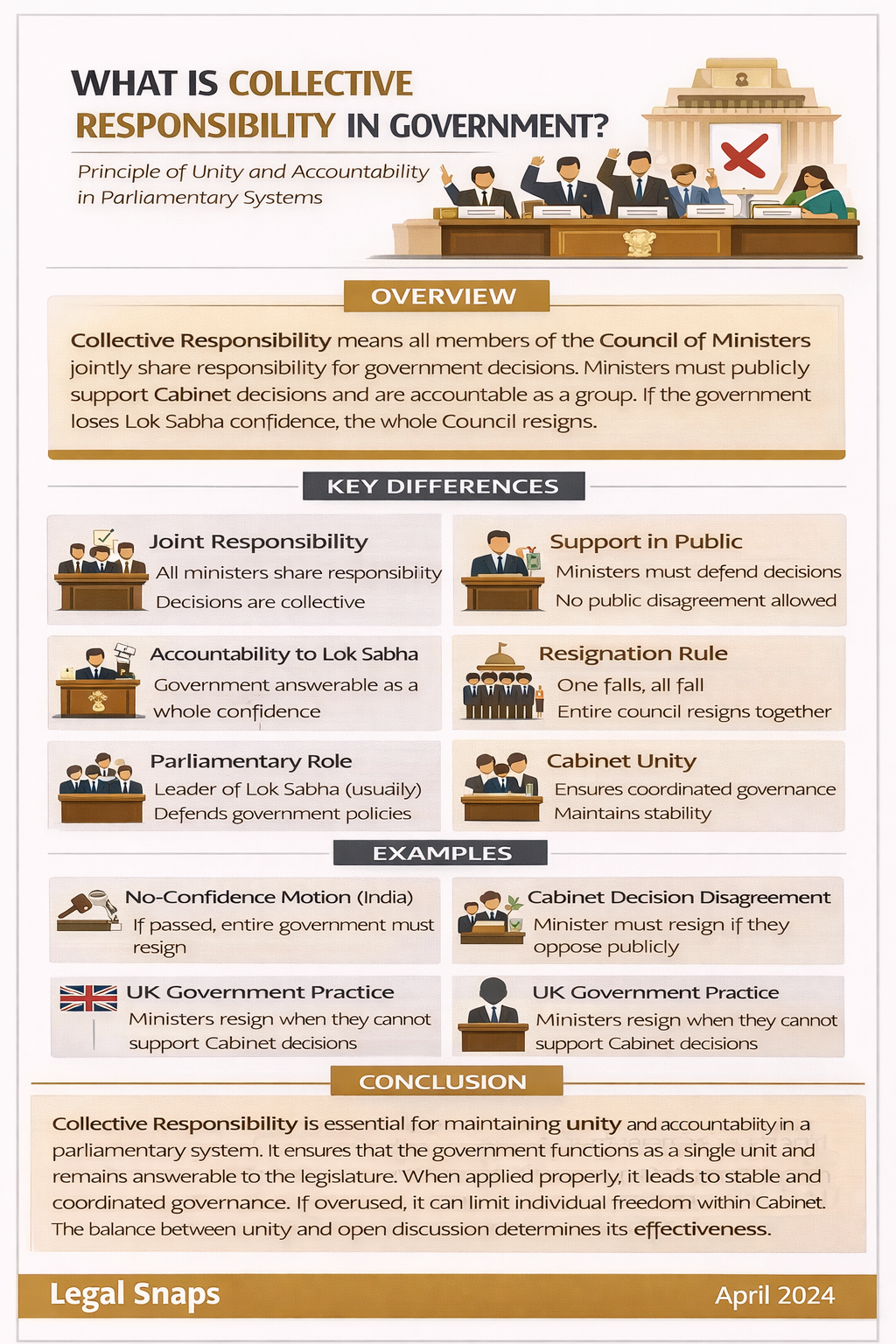
Collective Responsibility is a principle in the parliamentary system where all members of the Council of Ministers are jointly responsible for government decisions. Every minister is required to support decisions taken by the Cabinet, even if they personally disagree.The Council of Ministers is accountable as a group to the Lok Sabha. If the government loses the confidence of the Lok Sabha, the entire Council must resign. This ensures unity in decision-making and accountability, making it a core feature of parliamentary democracy.
Key Points
- Joint Responsibility: All ministers share responsibility; decisions are collective
- Support in Public: Ministers must defend decisions; no public disagreement allowed
- Accountability to Lok Sabha: Government answerable as a whole; subject to no-confidence motion
- Resignation Rule: One falls, all fall; entire council resigns together
- Cabinet Unity: Ensures coordinated governance and stability
Legal Analysis
Collective Responsibility strengthens unity by ensuring that the government speaks with one voice. This reduces confusion in governance and enables smoother implementation of policies.It also clarifies accountability, as the entire government is held responsible for its actions rather than individual ministers acting independently.
However, this principle can suppress individual opinions within the Council of Ministers. Ministers may be forced to publicly support decisions they privately disagree with, limiting internal dissent.In strong majority governments, it may also contribute to concentration of power within the Cabinet or the Prime Minister, reducing meaningful debate. Thus, while it promotes stability, it can restrict internal checks.
Examples
No-Confidence Motion (India): If passed in the Lok Sabha, the entire Council of Ministers must resign.
Cabinet Disagreement: A minister who publicly opposes a Cabinet decision is expected to resign.
United Kingdom: Ministers resign if they cannot support Cabinet decisions, maintaining collective responsibility.
Conclusion
Collective Responsibility is essential for maintaining unity and accountability in a parliamentary system. It ensures that the government functions as a single unit and remains answerable to the legislature.When applied effectively, it leads to stable and coordinated governance. However, excessive reliance on it can limit internal debate and individual ministerial independence. Its success depends on balancing unity with open discussion.