Under 17
How Government Policies Are Implemented
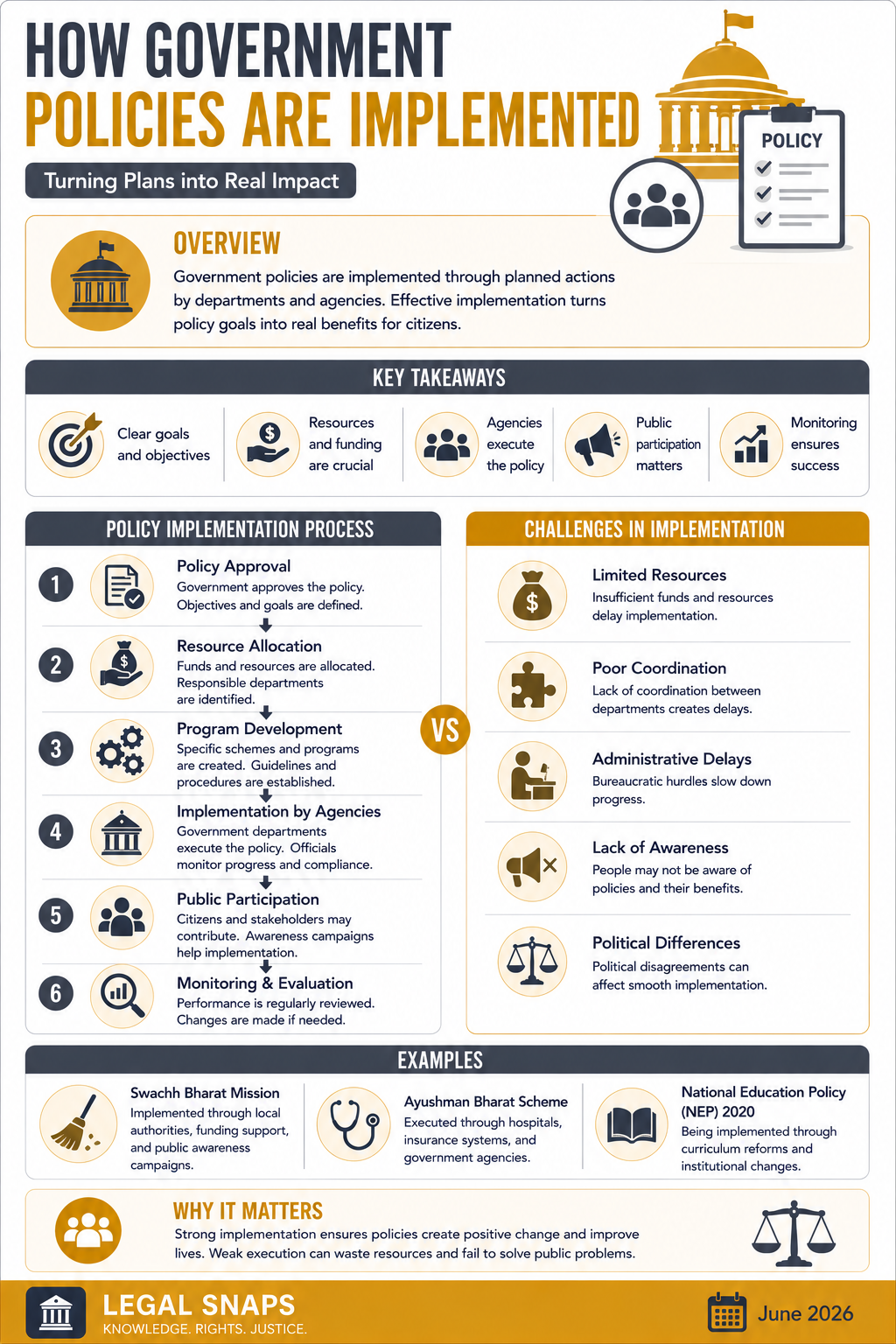
Government policies achieve real impact only when they are effectively implemented. Implementation transforms policy goals into programs, services, and actions that directly benefit citizens.

Overview
Policy implementation is the process through which approved government policies are converted into practical actions. Government departments, agencies, and institutions work together to execute policy objectives.Successful implementation requires planning, funding, coordination, and continuous monitoring to ensure that intended outcomes are achieved.
Key Points
- Policy Approval: Government finalizes objectives and goals
- Resource Allocation: Budget and manpower assigned
- Program Development: Schemes and guidelines created
- Execution: Departments and agencies implement policies
- Public Participation: Citizens and stakeholders contribute
- Monitoring: Progress tracked and reviewed regularly
- Evaluation: Improvements made based on results
Legal Analysis
Policy implementation is often more difficult than policy formulation. A well-designed policy may still fail if there is inadequate funding, weak administration, poor coordination, or insufficient public awareness.Government agencies play a central role in translating policy decisions into practical outcomes. Effective implementation requires clear responsibilities, accountability mechanisms, and cooperation between different levels of government.
In India, challenges such as bureaucratic delays, administrative inefficiencies, and resource limitations can affect implementation. Regular monitoring and evaluation help identify problems and improve performance.The ultimate success of any public policy depends not only on what is written in official documents but also on how effectively it is executed on the ground.
Examples
Swachh Bharat Mission: Implemented through local bodies, funding support, and public awareness campaigns.
Ayushman Bharat: Delivered through hospitals, insurance systems, and government agencies.
National Education Policy (NEP) 2020: Being implemented through curriculum reforms and institutional changes.
Conclusion
Effective policy implementation is essential for transforming government plans into meaningful results for citizens. Strong execution ensures that policy objectives translate into real improvements in public welfare and governance.When implementation is supported by adequate resources, accountability, and continuous evaluation, policies are more likely to achieve their intended goals. Weak implementation, however, can prevent even well-designed policies from succeeding.
“`