Under 17
Why USA follows Presidential but India follows Parliamentary
The USA and India follow different governance systems based on their historical context and political priorities. While the USA adopted a presidential system to ensure stability and separation of powers, India chose a parliamentary system to promote accountability and flexibility. These choices reflect different solutions to different governance challenges.
Overview
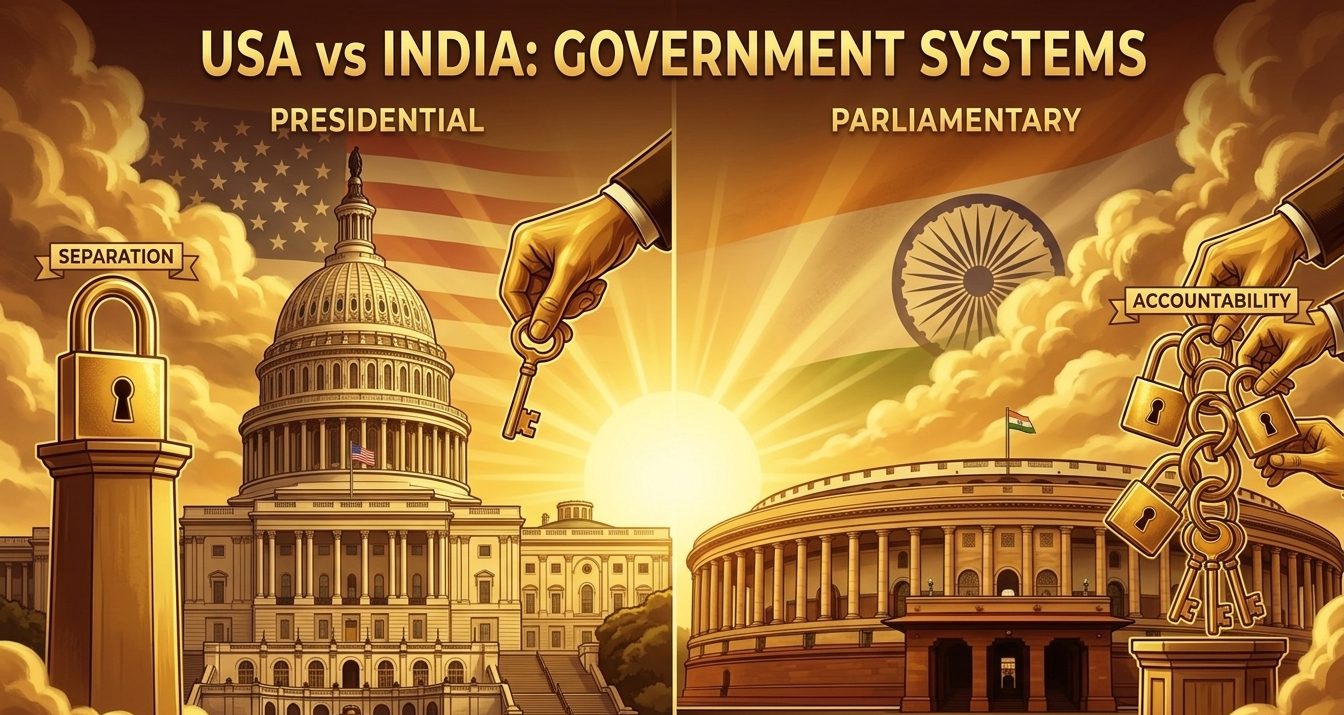
The USA and India follow different systems because of their history, political needs, and governance priorities. The USA adopted a presidential system to ensure strong separation of powers and prevent concentration of authority. India chose a parliamentary system to ensure accountability and flexibility in a diverse society.While the USA focused on stability and independence of branches, India focused on coordination and representation. These choices reflect what each country needed at the time of forming their constitutions. Both systems are designed for their specific contexts rather than being universally superior.
Key Points
- Historical Background: USA – reaction against monarchy with strong separation; India – influenced by British parliamentary model
- Governance Priority: USA – stability and fixed leadership; India – accountability and adaptability
- Power Structure: USA – clear separation of powers; India – executive linked with legislature
Legal Analysis
The USA’s presidential system provides stability through fixed tenure and a clear separation of powers. This ensures that no single branch dominates, preserving institutional independence. However, this separation can also lead to policy deadlock when different branches are controlled by opposing political forces.India’s parliamentary system, in contrast, allows closer coordination between the executive and legislature, enabling faster decision-making and continuous accountability. The government remains answerable to Parliament, which strengthens democratic oversight.
However, parliamentary systems can face instability, particularly during coalition periods where political bargaining becomes necessary. Strong majority governments may also shift the balance toward dominance, weakening opposition Ultimately, the USA prioritizes institutional independence, while India prioritizes coordination and responsiveness. Neither system is inherently better; each addresses different governance challenges based on national context.
Examples
USA Constitution (1787): Established a presidential system with strict separation of powers between executive, legislature, and judiciary.
India Constitution (1950): Adopted a parliamentary system to ensure accountable and representative governance.
US Government Shutdowns: Demonstrate deadlock between executive and legislature when agreement cannot be reached.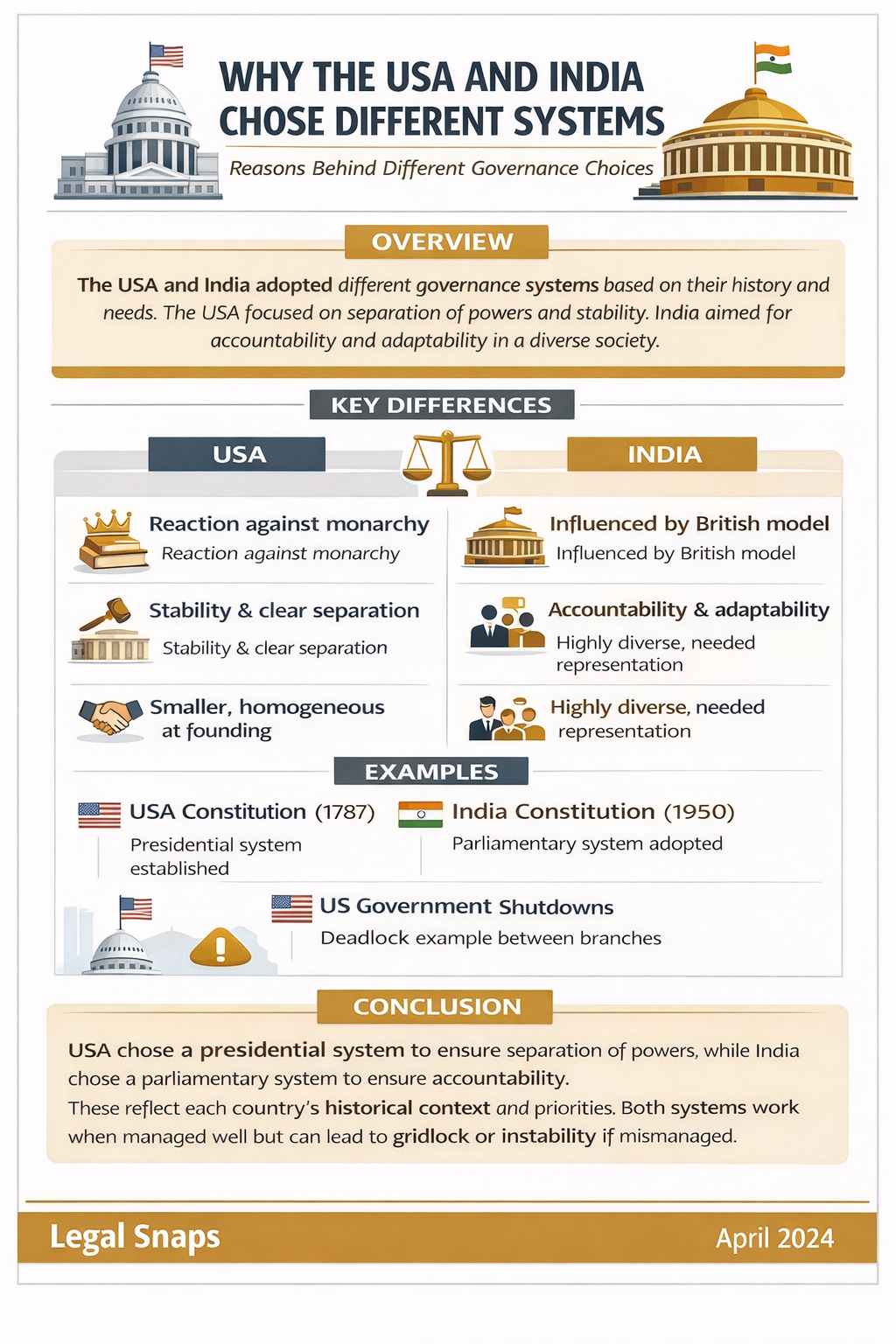
Conclusion
The USA follows a presidential system to ensure stability and limit power concentration through separation, while India follows a parliamentary system to ensure accountability and manage diversity. Each system reflects the country’s historical context and political needs.When used effectively, both systems can deliver strong governance. However, mismanagement can lead to gridlock in presidential systems or instability in parliamentary systems. The structure sets the framework, but outcomes ultimately depend on leadership and institutional strength.