Under 17
Why India chose Parliamentary System over Presidential System
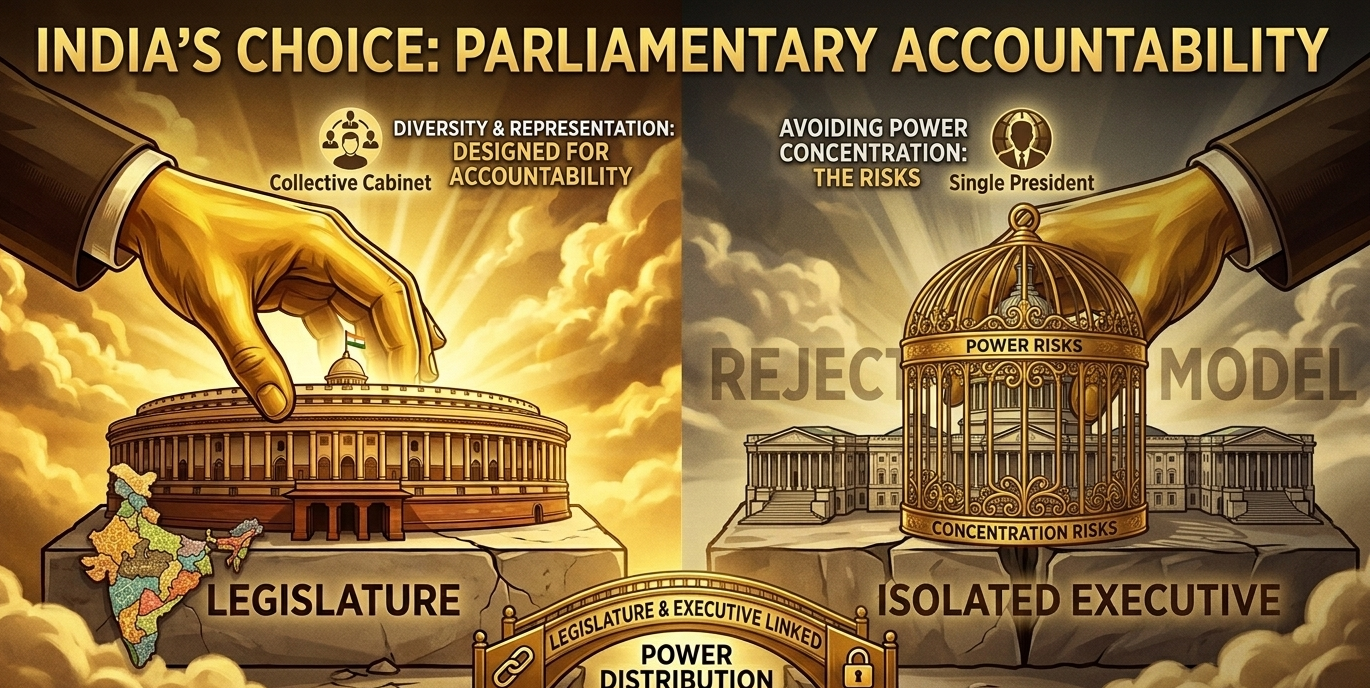
India adopted the parliamentary system to ensure accountability, flexibility, and representation in a highly diverse society. By linking the executive to the legislature, it prevents concentration of power while allowing governments to adapt to changing political conditions. However, its success depends on political maturity, as it can lead to instability or dominance if misused.
Overview
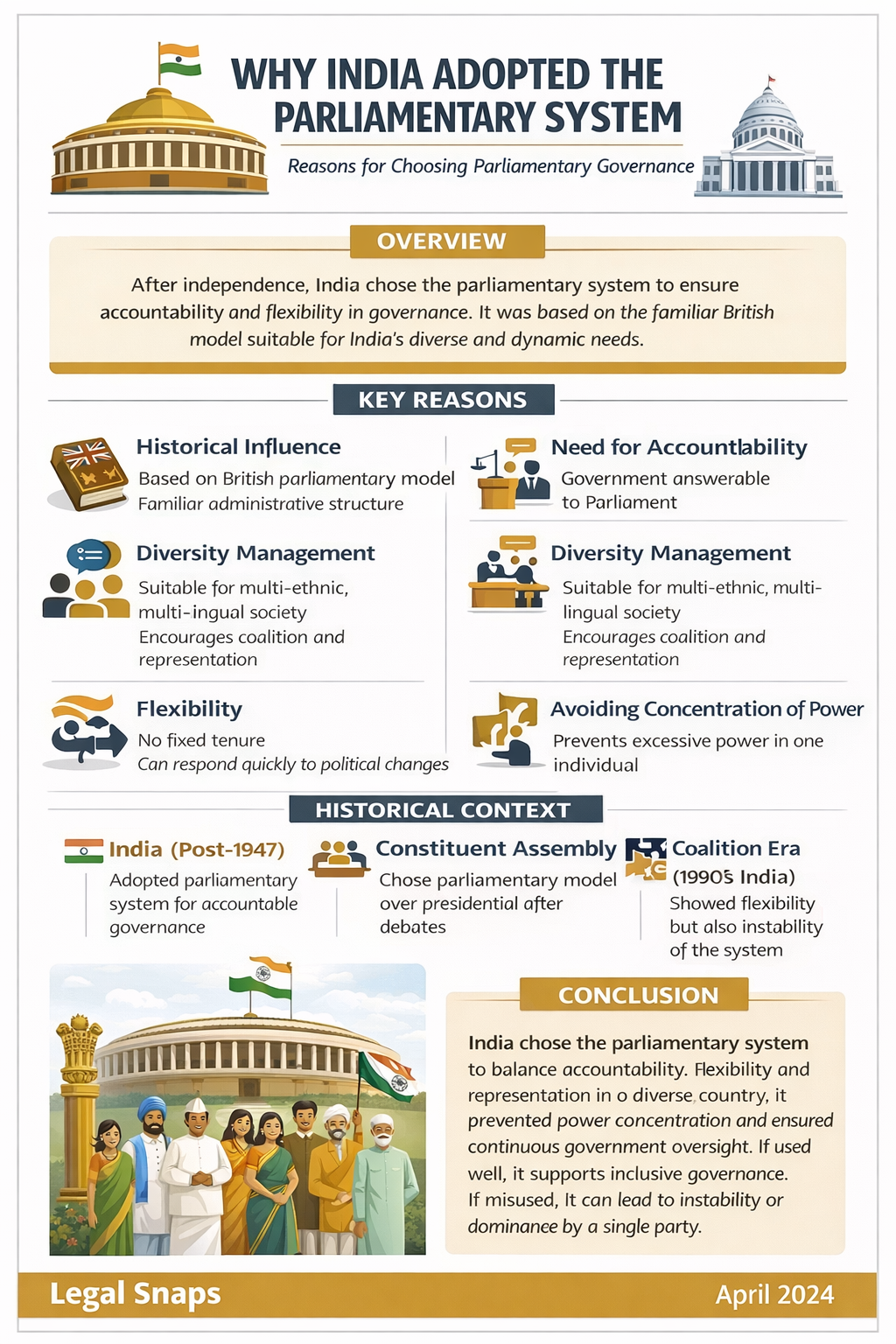
India chose the parliamentary system after independence to ensure accountability and flexibility in governance. The leaders wanted a system where the executive is directly responsible to the legislature. Given India’s diversity, they needed a system that could adapt to changing political situations.The British model was already familiar due to colonial rule, making adoption easier. It also allowed better representation of different groups. Overall, it was seen as more suitable for a newly independent and diverse country.
Key Points
- Historical Influence: Based on British parliamentary model; familiar administrative structure
- Need for Accountability: Government answerable to Parliament; removable through no-confidence motion
- Diversity Management: Suitable for multi-ethnic, multi-lingual society; encourages representation
- Flexibility: No fixed tenure; can respond quickly to political changes
- Avoiding Concentration of Power: Prevents excessive power in one individual; promotes collective decision-making
Legal Analysis
The parliamentary system was effective in India’s early years as it ensured accountability and avoided concentration of power in a single leader. It allowed smooth coordination between the executive and legislature, which was critical during the nation-building phase.However, the system also introduced challenges. Coalition governments, especially during the 1990s, led to instability and frequent political bargaining. Decision-making often slowed due to competing interests within alliances.
In recent years, strong majority governments have reduced instability but raised concerns about excessive dominance by a single party. This shifts the balance away from effective opposition and weakens practical checks and balances.Thus, while structurally suitable for India, the effectiveness of the parliamentary system depends less on constitutional design and more on political behavior and institutional strength.
Examples
India (Post-1947): Adopted the parliamentary system to ensure accountable and representative governance.
Constituent Assembly Decision: Chose the parliamentary model over the presidential system after extensive debates.
Coalition Era (1990s India): Demonstrated both the flexibility and instability of the system in practice.
Conclusion
India chose the parliamentary system to balance accountability, flexibility, and representation in a diverse society. It helped prevent concentration of power and ensured continuous legislative oversight.However, the system’s success is not automatic. Weak coalitions can create instability, while strong majorities can lead to dominance. Ultimately, outcomes depend on how political leaders and institutions function within the system.