Under 17
What is a Presidential Ordinance?
A Presidential Ordinance is a temporary law issued when Parliament is not in session to handle urgent situations. It has the same force as a law but must be approved by Parliament within a limited time. While it enables quick action, it can be controversial if used to bypass legislative debate.
Overview
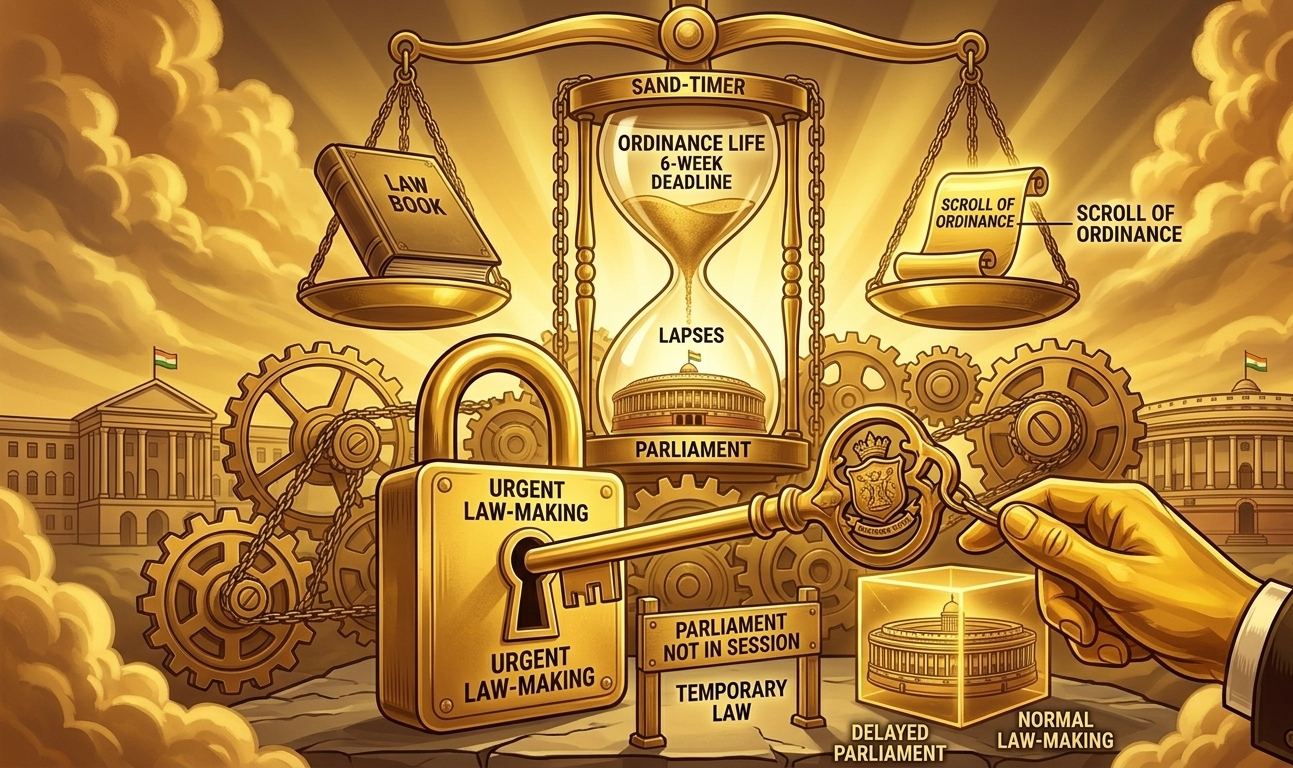
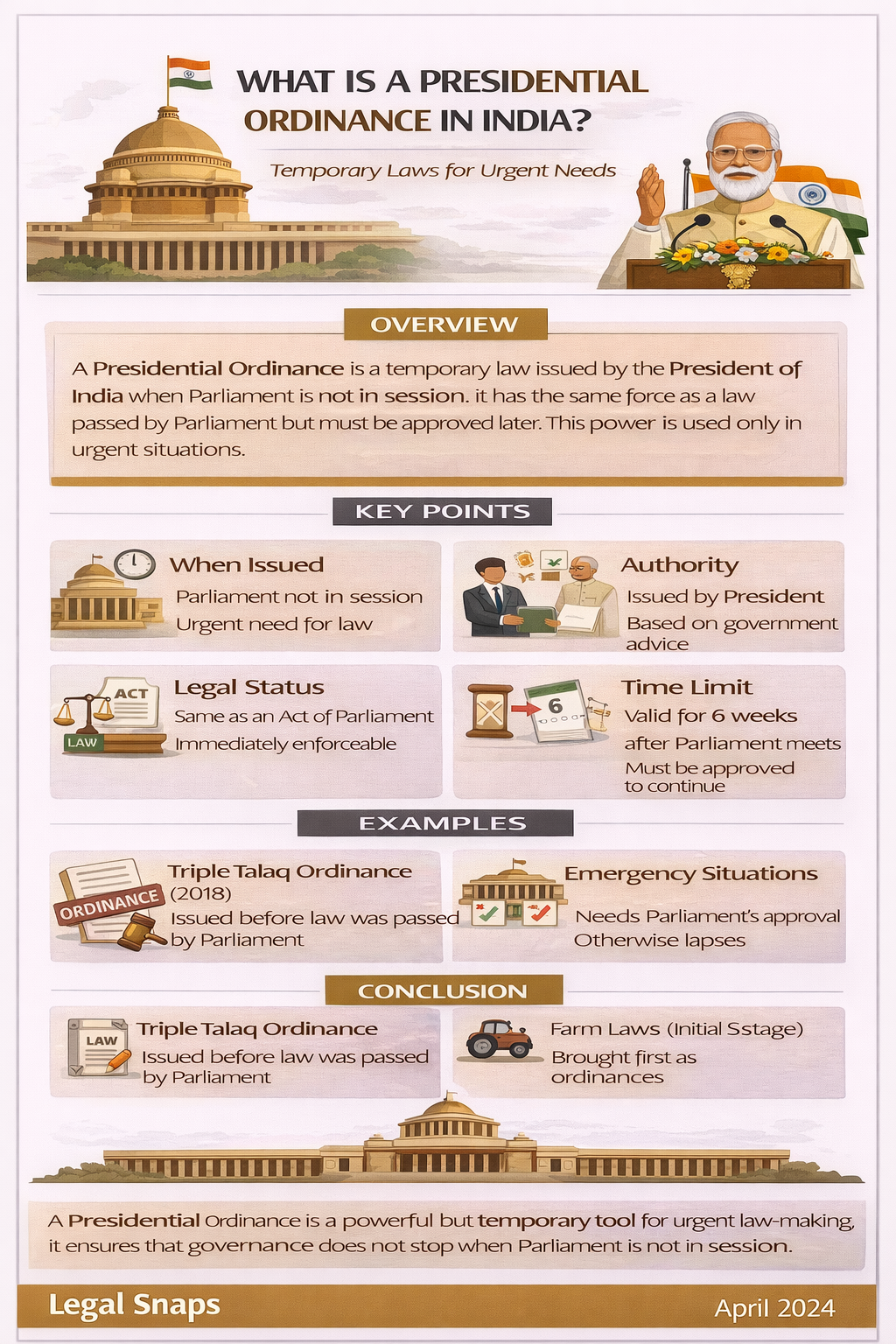
A Presidential Ordinance is a temporary law issued by the President of India when Parliament is not in session. It is used to address urgent situations that cannot wait for the normal legislative process.The ordinance carries the same legal force as a law passed by Parliament. However, it is not permanent and must be approved by Parliament after it reconvenes. The President issues ordinances on the advice of the Council of Ministers.
Key Points
- When Issued: Parliament is not in session and there is an urgent need for law
- Authority: Issued by the President on the advice of the government
- Legal Status: Has the same force as an Act of Parliament and is immediately enforceable
- Time Limit: Valid for six weeks after Parliament reconvenes
- Approval Requirement: Must be approved by Parliament or it lapses
Legal Analysis
The ordinance power allows the government to respond quickly to urgent situations without waiting for Parliament to reconvene. This ensures continuity in governance and timely decision-making.However, this power can be misused to bypass parliamentary debate and scrutiny. Frequent reliance on ordinances weakens the role of the legislature and undermines democratic processes.
The Supreme Court has also raised concerns about repeated re-promulgation of ordinances, emphasizing that this practice should not replace proper law-making.Thus, while the ordinance power is necessary, its legitimacy depends on limited and responsible use.
Examples
Triple Talaq Ordinance (2018): Issued before the law was formally passed by Parliament.
Farm Laws (Initial Stage): Introduced first through ordinances before legislative approval.
Re-promulgation Cases: The Supreme Court criticized repeated use of ordinances without parliamentary approval.
Conclusion
A Presidential Ordinance is a powerful but temporary mechanism for urgent law-making. It ensures that governance continues even when Parliament is not in session.When used responsibly, it enables quick action. However, misuse can bypass democratic debate and weaken legislative authority. Its effectiveness depends on restraint and proper constitutional use.