Under 17
Role of President during emergencies
During emergencies, the President of India becomes the formal authority through which extraordinary powers are exercised. While acting on Cabinet advice, the President’s approval activates provisions that shift power toward the Union. These powers ensure stability in crises but carry serious risks if misused.
Overview
The President of India plays a crucial role during emergencies, as all emergency powers are formally exercised in their name. These emergencies include National, State, and Financial emergencies.Although the President acts on the advice of the Council of Ministers, their approval is required to activate these provisions. During emergencies, the balance of power shifts, and the central government gains increased control to manage the situation.
Key Points
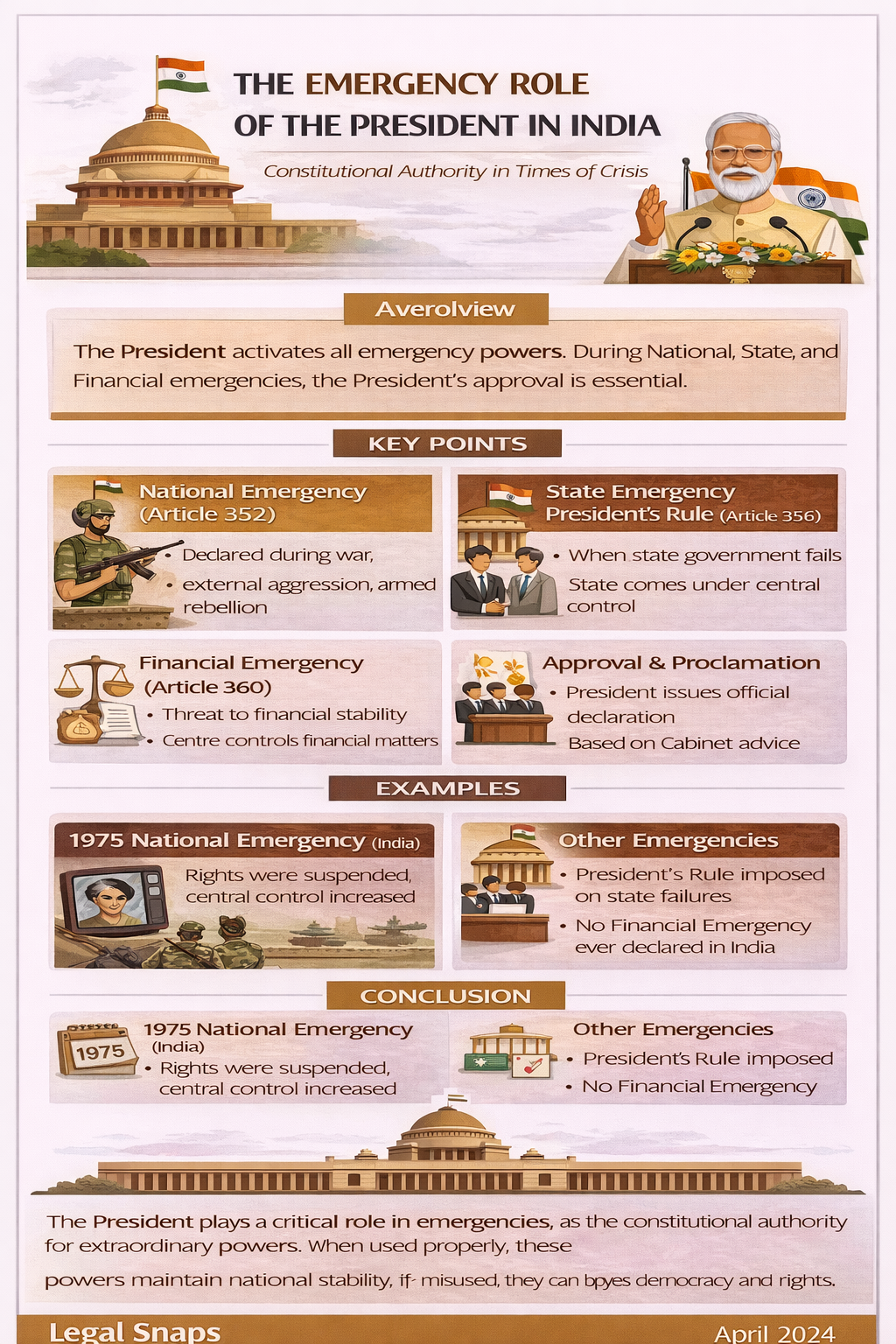
- National Emergency (Article 352): Declared during war, external aggression, or armed rebellion; expands Union power
- State Emergency / President’s Rule (Article 356): Imposed when a state government fails; brings the state under central control
- Financial Emergency (Article 360): Declared when financial stability is threatened; Centre gains control over financial matters
- Approval & Proclamation: President issues the official declaration based on Cabinet advice
- Impact on Rights & Governance: Certain fundamental rights may be restricted; central authority increases
Legal Analysis
The President’s role during emergencies is constitutionally significant but largely guided by ministerial advice. These provisions allow the government to take swift and unified action during serious crises.However, the concentration of power during emergencies carries inherent risks. The 1975 National Emergency demonstrated how such powers can be used to restrict fundamental rights and weaken democratic safeguards.
This makes constitutional limits, judicial review, and political accountability critical in preventing misuse. Emergency provisions are necessary, but their legitimacy depends on restraint and proper application.Thus, the President acts as the formal authority enabling emergency powers, but the real challenge lies in ensuring they are used responsibly.
Examples
1975 National Emergency (India): Led to suspension of fundamental rights and expansion of central authority.
President’s Rule in States: Frequently imposed when state governments fail to function constitutionally.
Financial Emergency: Provided for in the Constitution but has not been used in India so far.
Conclusion
The President plays a central role in declaring and managing emergencies, acting as the constitutional authority for extraordinary powers. These powers are essential for maintaining national stability during crises.However, misuse can seriously harm democracy and fundamental rights. The effectiveness of this role depends on responsible governance, constitutional safeguards, and institutional checks.