Under 17
Powers of the Supreme Court
The Supreme Court of India possesses extensive constitutional powers that enable it to protect fundamental rights, interpret laws, review government actions, and maintain constitutional balance. These powers make it the guardian of the Constitution and the final authority in legal disputes.
Overview
The Supreme Court is the highest court in India and exercises a wide range of powers under the Constitution. It serves as the guardian of constitutional values, protector of fundamental rights, and final interpreter of laws.Its decisions are binding on all courts across the country. Through its various jurisdictions and constitutional powers, the Court plays a central role in preserving democracy, justice, and the rule of law.
Key Points
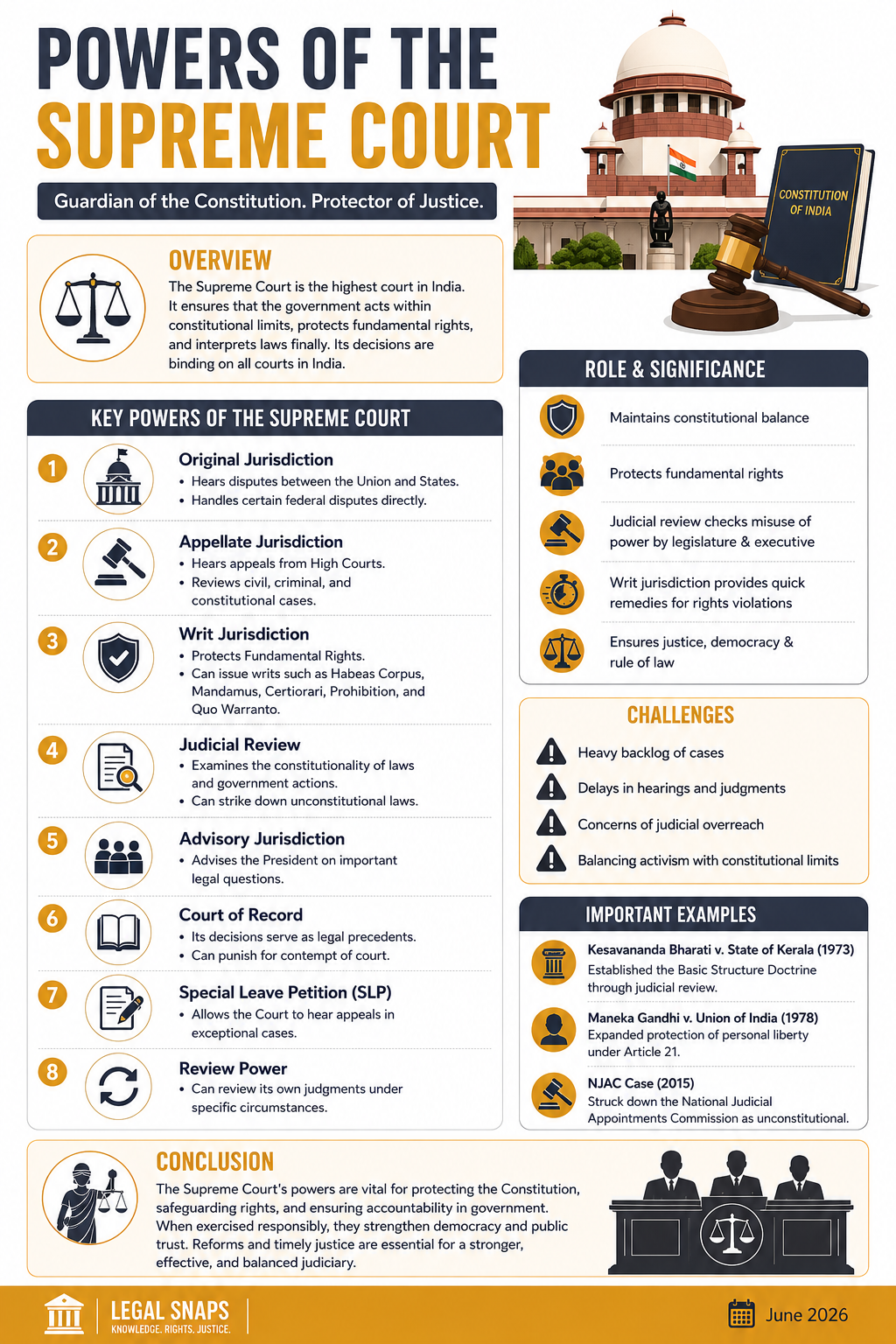
- Original Jurisdiction: Resolves disputes between the Union and States
- Appellate Jurisdiction: Hears appeals from High Courts and lower courts
- Writ Jurisdiction: Protects Fundamental Rights through constitutional remedies
- Judicial Review: Examines the validity of laws and government actions
- Advisory Jurisdiction: Advises the President on important legal questions
- Court of Record: Maintains precedents and punishes for contempt
- Special Leave Petition: Allows exceptional appeals before the Court
- Review Power: Can review its own judgments in specific situations
Legal Analysis
The Supreme Court’s broad powers help maintain constitutional balance and protect citizens against arbitrary actions of the State. Judicial review serves as an important safeguard by ensuring that laws and executive actions remain within constitutional limits.Its writ jurisdiction provides direct remedies when fundamental rights are violated, making the Court a vital protector of individual liberty and constitutional freedoms.
At the same time, the Court faces challenges such as heavy case backlogs, delays in disposal, and debates regarding judicial activism and judicial overreach.Maintaining a balance between active constitutional protection and respect for democratic institutions remains one of the Court’s most important responsibilities.
Examples
Kesavananda Bharati v. State of Kerala (1973): Established the Basic Structure Doctrine through judicial review.
Maneka Gandhi v. Union of India (1978): Expanded protection of personal liberty under Article 21.
NJAC Case (2015): Struck down the National Judicial Appointments Commission as unconstitutional.
Conclusion
The powers of the Supreme Court are essential for protecting the Constitution, safeguarding fundamental rights, and ensuring accountability within government institutions.When exercised responsibly, these powers strengthen democracy, uphold the rule of law, and maintain public confidence in the justice system. A strong, independent, and balanced Supreme Court remains vital for the success of India’s constitutional democracy.
“`