Under 17
Difference Between High Court and Supreme Court
The High Court and Supreme Court are key pillars of India’s judicial system. While High Courts operate at the state level, the Supreme Court serves as the highest judicial authority in the country.

Overview
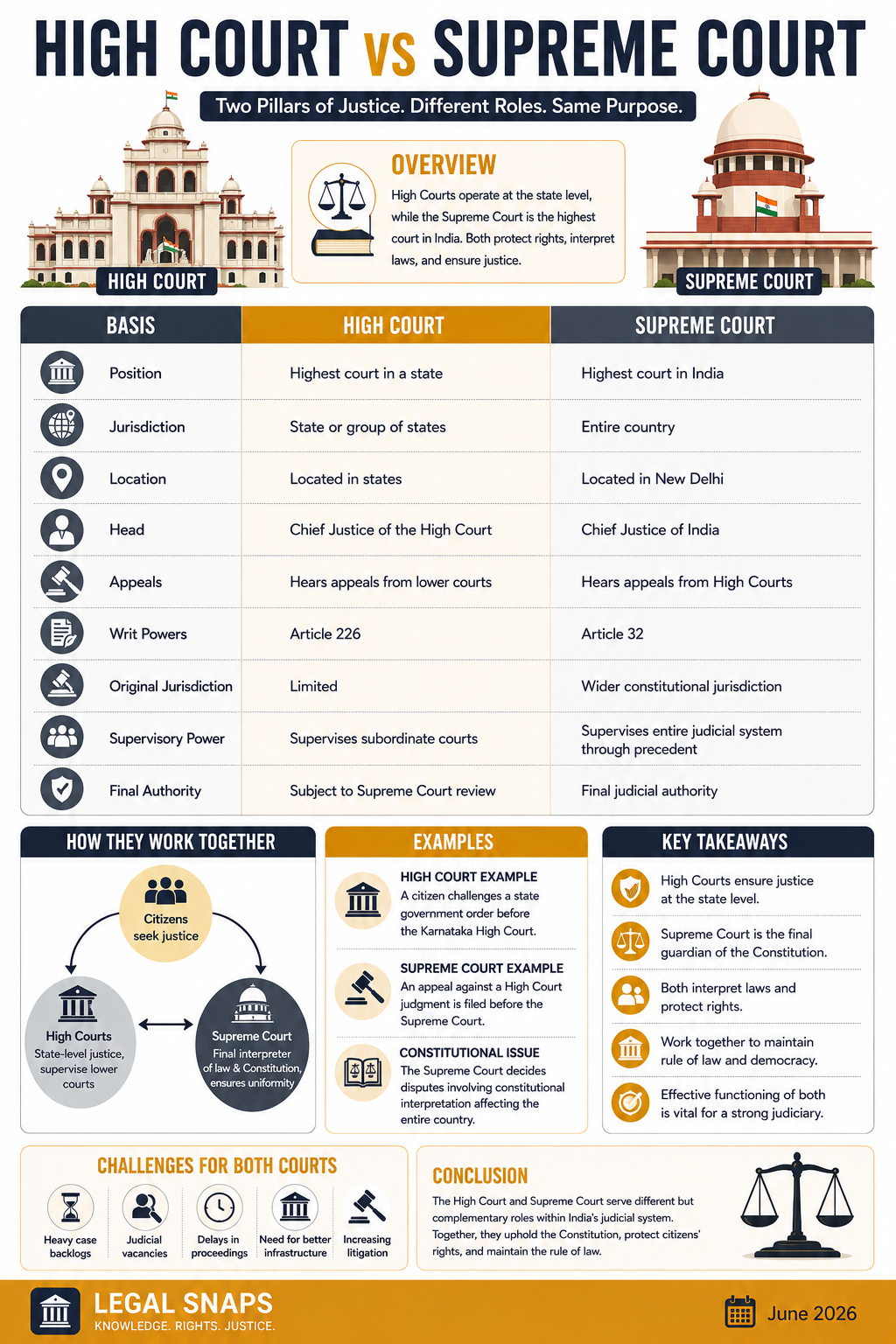
The High Court and the Supreme Court are two important levels of the Indian judiciary. Both institutions protect rights, interpret laws, and ensure justice, but they differ in jurisdiction, authority, and constitutional responsibilities.High Courts function at the state level, whereas the Supreme Court exercises authority across the entire country. Together, they ensure the effective administration of justice and uphold the Constitution.
Key Points
- Position: High Court (State Level) | Supreme Court (National Level)
- Jurisdiction: State/UT Jurisdiction | Entire India
- Head: Chief Justice of High Court | Chief Justice of India
- Appeals: Reviews lower court decisions | Reviews High Court decisions
- Writ Powers: Article 226 | Article 32
- Authority: Subject to Supreme Court review | Final judicial authority
Legal Analysis
Both courts are essential for maintaining constitutional governance and protecting citizens’ rights. High Courts provide easier access to justice at the state level and supervise subordinate courts within their jurisdiction.The Supreme Court ensures uniform interpretation of laws throughout the country and acts as the final guardian of the Constitution. Its decisions are binding on all courts in India.
High Courts handle a large number of civil, criminal, and constitutional disputes arising within states. The Supreme Court primarily deals with constitutional questions, disputes of national importance, and appeals from High Courts.Despite their importance, both institutions face challenges such as judicial vacancies, case backlogs, and delays in proceedings, highlighting the need for continuous judicial reforms.
Examples
High Court Example: A citizen challenges a state government order before the Karnataka High Court.
Supreme Court Example: An appeal against a High Court judgment is filed before the Supreme Court.
Constitutional Matter: The Supreme Court interprets constitutional provisions affecting the entire country.
Conclusion
The High Court and Supreme Court perform different but complementary functions within India’s judicial system. High Courts ensure justice and constitutional protection at the state level, while the Supreme Court serves as the final authority on legal and constitutional issues.Together, they uphold the Constitution, protect fundamental rights, and maintain the rule of law. Their efficient functioning remains essential for a strong, independent, and accessible judiciary.
“`