Under 17
Can Supreme Court overrule Parliament?
The Supreme Court cannot replace Parliament or make laws on its behalf. However, it can review laws passed by Parliament and strike them down if they violate the Constitution.
Overview
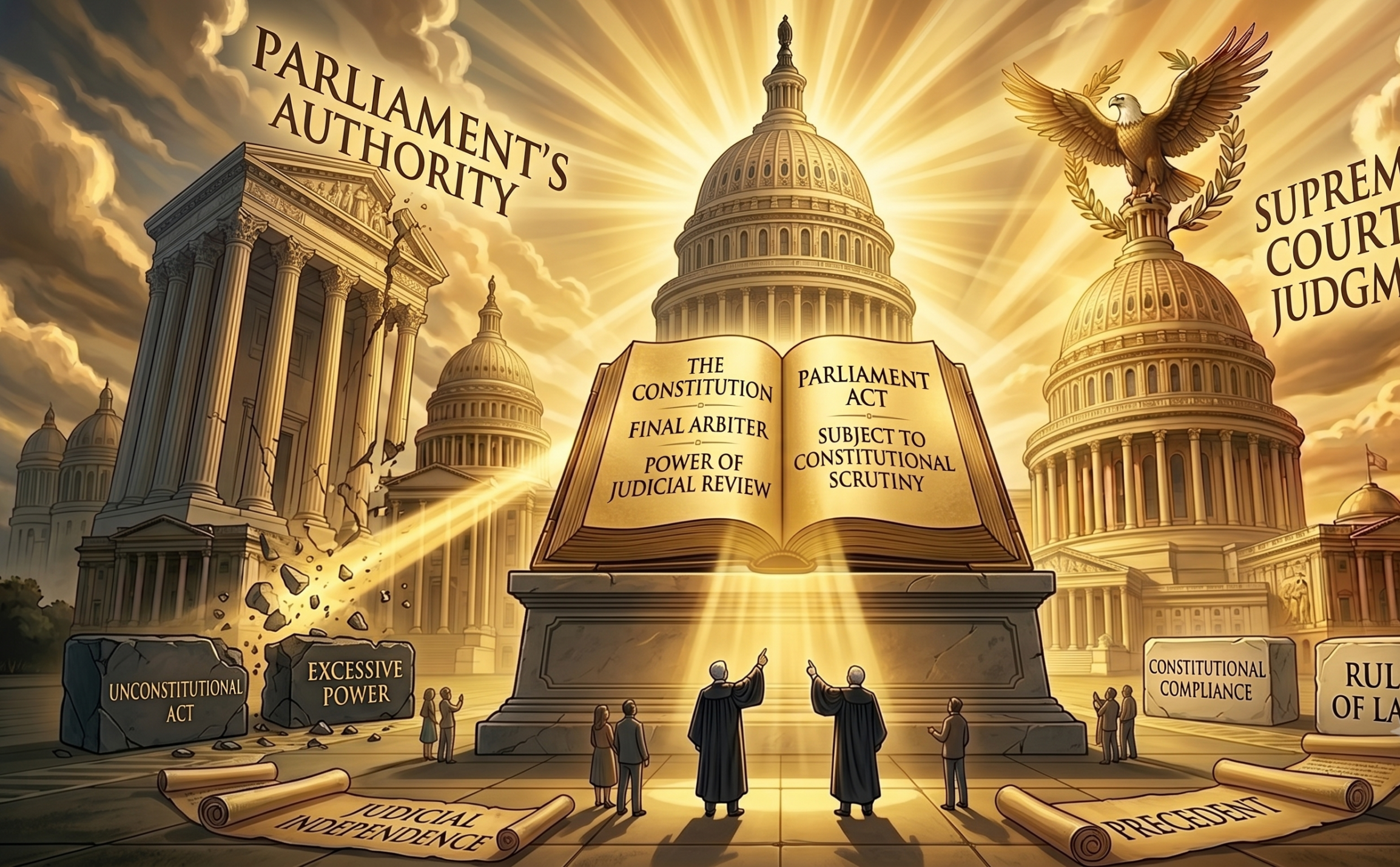
The Supreme Court and Parliament perform different constitutional functions. Parliament is responsible for making laws, while the Supreme Court interprets laws and ensures they comply with the Constitution.If a law passed by Parliament violates constitutional provisions, the Supreme Court can declare it unconstitutional through the power of Judicial Review. This helps maintain constitutional supremacy and institutional balance.
Key Points
- Parliament Makes Laws: Enacts legislation and constitutional amendments
- Supreme Court Interprets Laws: Resolves disputes and explains legal meaning
- Judicial Review: Can examine and invalidate unconstitutional laws
- Basic Structure Doctrine: Protects core features of the Constitution
- No Direct Overruling: Court cannot perform Parliament’s law-making role
Legal Analysis
The relationship between Parliament and the Supreme Court is based on constitutional checks and balances rather than institutional superiority. Both derive their powers from the Constitution and operate within defined limits.Parliament possesses broad legislative authority, but its powers are not unlimited. Through Judicial Review, the Supreme Court ensures that laws and constitutional amendments remain consistent with constitutional principles.
The Basic Structure Doctrine further limits Parliament’s amending power by preventing changes that would alter the Constitution’s essential framework.While debates occasionally arise regarding judicial activism and parliamentary supremacy, the constitutional system is designed to maintain a balance between democratic governance and constitutional protection.
Examples
Kesavananda Bharati (1973): Supreme Court established the Basic Structure Doctrine.
NJAC Case (2015): Court struck down a constitutional amendment relating to judicial appointments.
Minerva Mills (1980): Reaffirmed limits on Parliament’s power to amend the Constitution.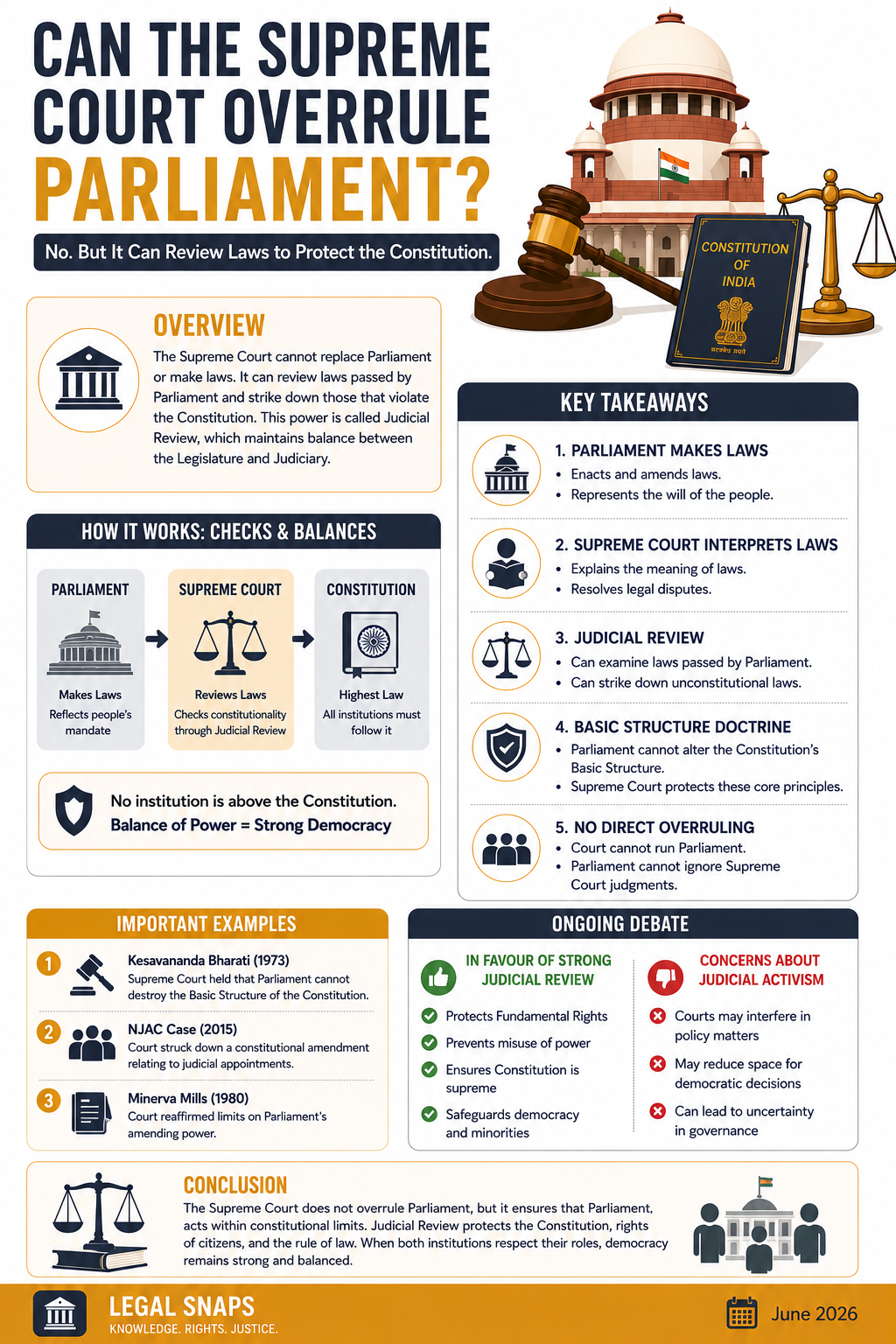
Conclusion
The Supreme Court cannot overrule Parliament by taking over its legislative role. However, it can invalidate laws and constitutional amendments that violate the Constitution.This constitutional arrangement ensures that no institution is above the Constitution. When Parliament and the Supreme Court function within their respective roles, they strengthen democracy, accountability, and the rule of law in India.
“`