Under 17
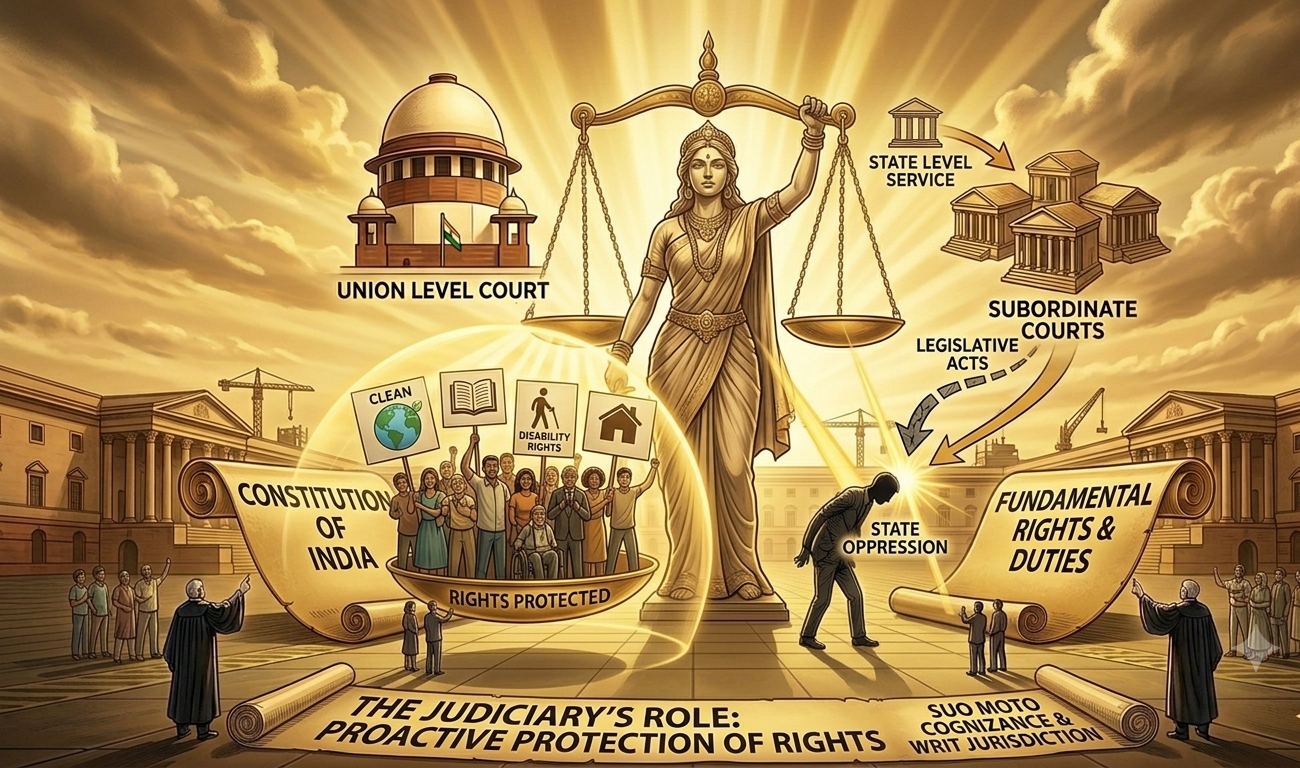
The judiciary acts as the guardian of citizens’ rights by ensuring that laws and government actions comply with the Constitution. Through judicial review and constitutional remedies, courts protect individual freedoms and uphold the rule of law.
Overview
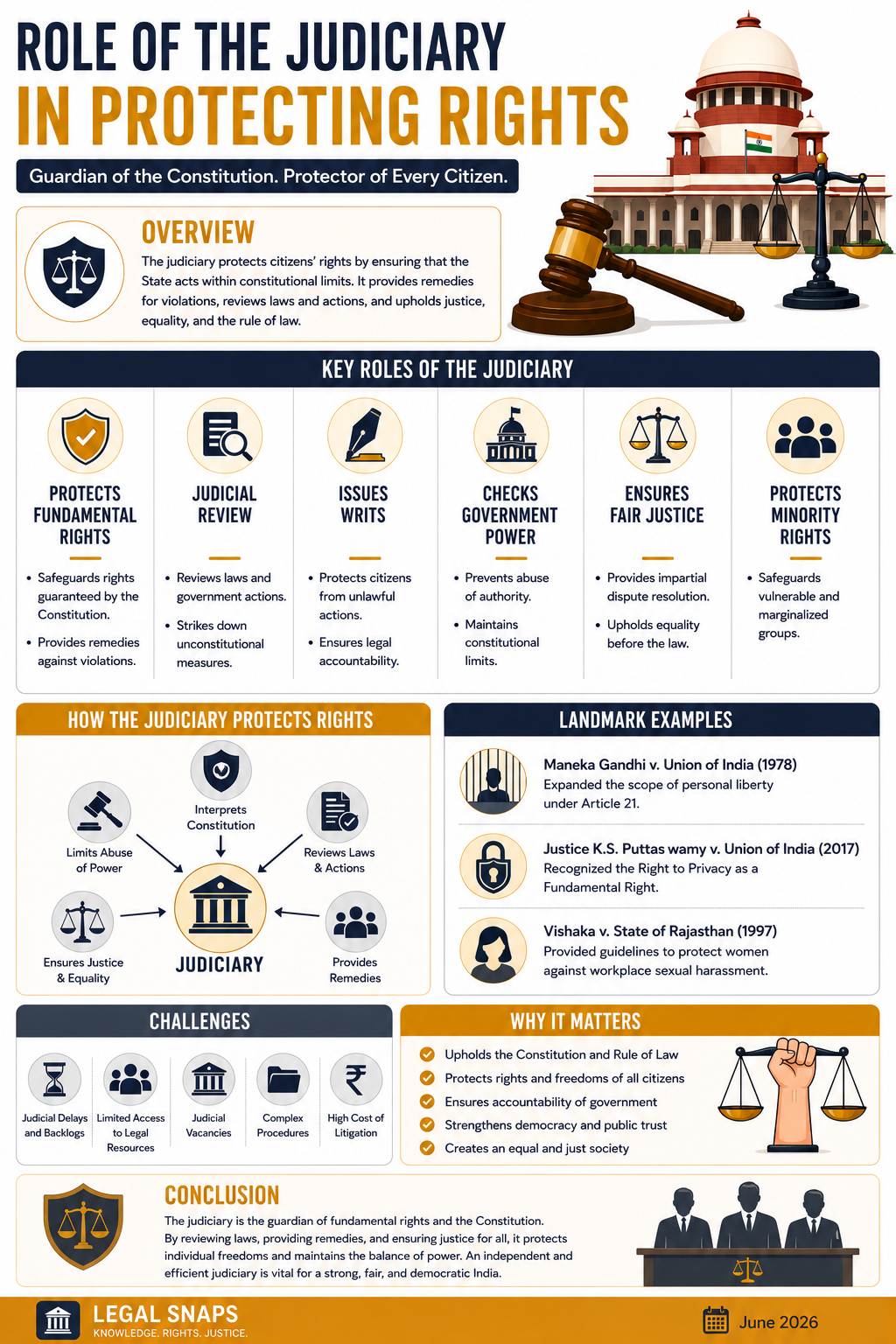
The judiciary plays a vital role in protecting the rights and freedoms guaranteed under the Constitution of India. It ensures that government authorities act within constitutional limits and respect individual liberties.Courts provide remedies when rights are violated and help maintain justice, equality, and accountability. Through their constitutional powers, they serve as a safeguard against arbitrary use of power.
Key Points
- Protects Fundamental Rights: Safeguards constitutional freedoms
- Judicial Review: Reviews laws and government actions
- Issues Writs: Provides remedies against rights violations
- Checks Government Power: Prevents abuse of authority
- Ensures Fair Justice: Upholds equality before law
- Protects Minority Rights: Safeguards vulnerable groups
Legal Analysis
An independent judiciary is essential for maintaining constitutional governance and protecting individual freedoms. Courts act as neutral institutions that can review executive and legislative actions without political influence.Through judicial review, courts ensure that laws and policies remain consistent with constitutional principles. This power prevents arbitrary actions and strengthens democratic accountability.
Landmark judgments have expanded the scope of personal liberty, privacy, gender equality, and access to justice, demonstrating the judiciary’s evolving role in protecting rights.Although challenges such as judicial delays and case backlogs remain, the judiciary continues to serve as one of the strongest safeguards against violations of constitutional rights.
Examples
Maneka Gandhi v. Union of India (1978): Expanded the interpretation of personal liberty under Article 21.
Justice K.S. Puttaswamy v. Union of India (2017): Recognized the Right to Privacy as a Fundamental Right.
Vishaka v. State of Rajasthan (1997): Established protections against workplace sexual harassment.
Conclusion
The judiciary is a cornerstone of constitutional democracy and plays a crucial role in protecting rights, enforcing the Constitution, and maintaining the rule of law.By reviewing government actions, providing remedies for rights violations, and ensuring equal justice, courts strengthen democracy and public confidence in the legal system. Preserving judicial independence remains essential for safeguarding the freedoms of all citizens.
“`