Under 17
What is a Parliamentary System?
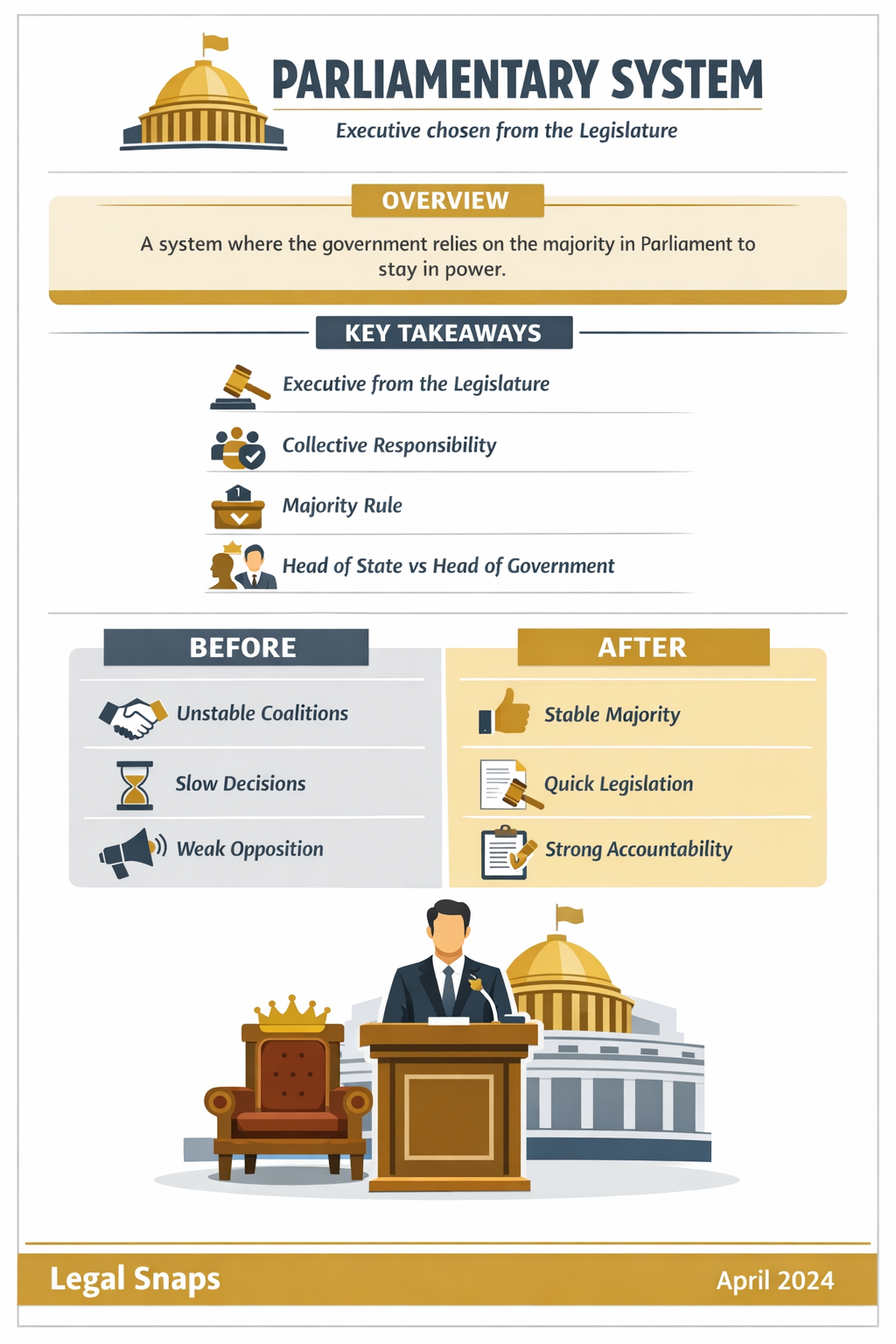
The parliamentary system links the executive directly to the legislature, ensuring real-time accountability.Governments survive only with majority support, making political stability crucial Core principles like collective responsibility and no-confidence motions keep power in check.Effective in strong majorities—but vulnerable to instability and dominance when misused.
Overview
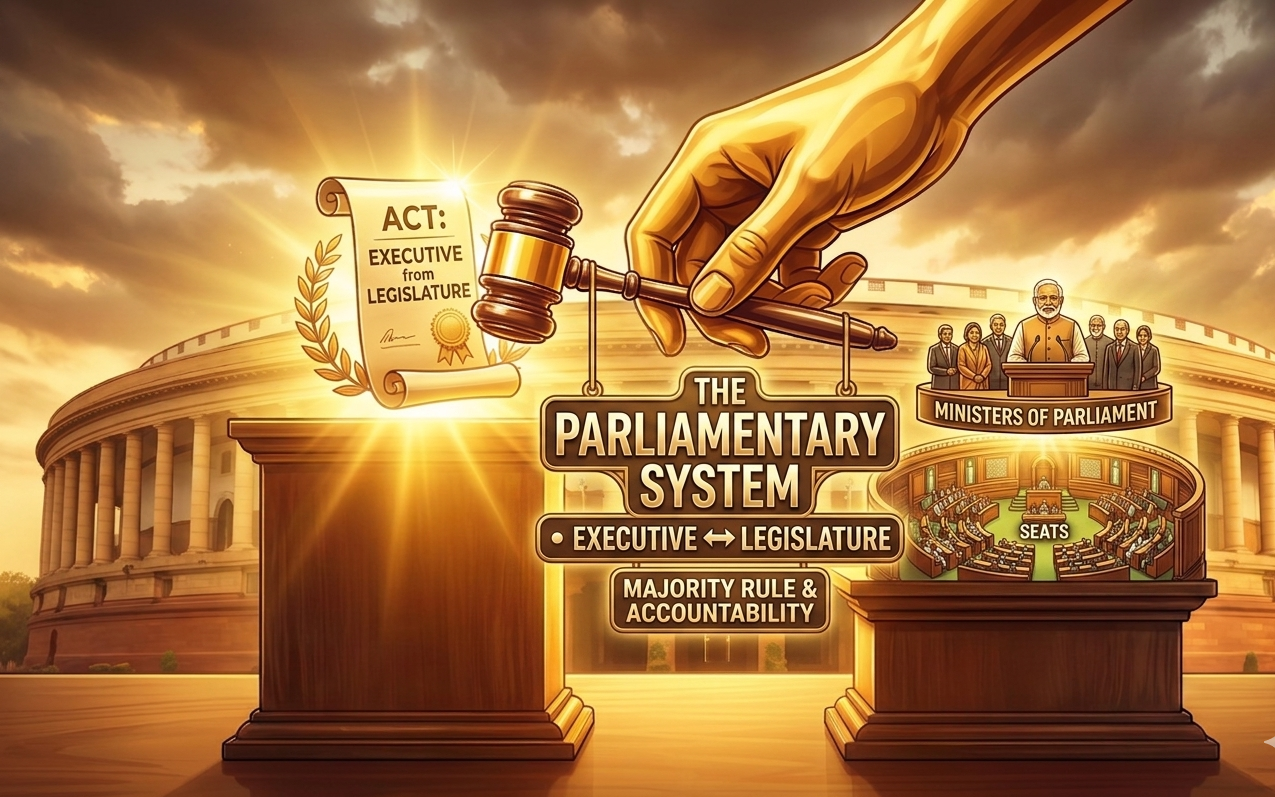
The parliamentary system is a form of democratic governance where the executive derives its authority from the legislature. The Prime Minister and the Council of Ministers are members of Parliament and remain in power only as long as they enjoy the confidence of the majority. This system is followed in countries like India, the United Kingdom, and Canada, and is designed to ensure close coordination between law-making and administration.The central idea behind the system is political accountability. The government is not independent of the legislature but is directly answerable to it. This creates a structure where decision-making is faster, but at the same time, the stability of the government depends heavily on maintaining majority support in Parliament.
Key Points
- Executive is drawn from the Legislature
- Prime Minister is typically the leader of the majority party
- Ministers must be members of Parliament
- Principle of Collective Responsibility applies
- Entire cabinet is accountable to Parliament
- Government must maintain majority support
- Loss of majority leads to resignation or dissolution
- No-confidence motion can remove the government
Legal Analysis
The parliamentary system reflects core constitutional principles such as accountability, representation, and responsible government. In India, this structure is embedded in the Constitution, particularly through Articles 74 and 75, which establish the Council of Ministers and their responsibility to the Lok Sabha.A key feature is collective responsibility, which ensures that the executive acts as a unified body. This prevents fragmented governance and enforces political discipline. At the same time, mechanisms like Question Hour, debates, and no-confidence motions ensure continuous legislative oversight.
However, the system depends heavily on political realities. A strong majority leads to stable governance, but coalition governments often result in compromises and instability. Additionally, excessive dominance by a single party can weaken effective opposition, reducing the practical functioning of checks and balances.Thus, while constitutionally sound, the effectiveness of the parliamentary system ultimately depends on political maturity, party discipline, and respect for democratic norms rather than just legal provisions.
Examples
India: The Prime Minister and Council of Ministers are responsible to the Lok Sabha and can be removed through a no-confidence motion.
United Kingdom: The Prime Minister leads the government, while the Monarch acts as a ceremonial head of state.
Canada: The Prime Minister is accountable to the elected House of Commons under a similar parliamentary structure.
Conclusion
The parliamentary system ensures a strong link between the legislature and executive, promoting accountability and relatively faster decision-making. It is particularly effective in systems with stable majority governments.However, its success is not guaranteed by structure alone. Weak coalitions, political opportunism, or excessive majority control can distort its functioning. In the long run, its strength lies in balanced political practice, not just constitutional design.