Under 17
Landmark Judgements You Should Know
Landmark judgments are court decisions that shape constitutional interpretation, strengthen rights, and influence future legal developments. These cases form the foundation of modern Indian constitutional law.

Overview
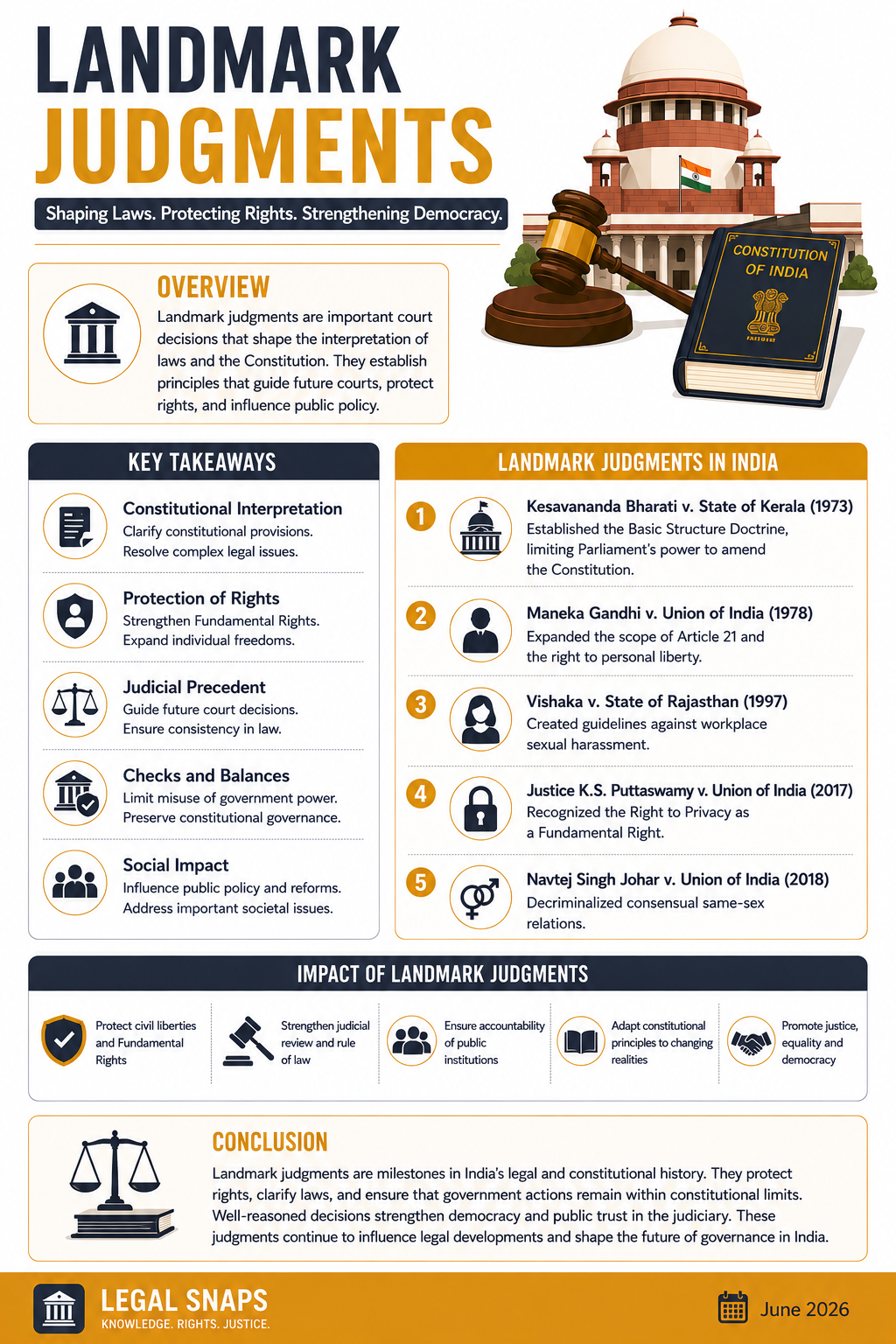
Landmark judgments are important court decisions that have significantly influenced the interpretation of laws and the Constitution. These decisions establish legal principles that guide future courts and shape public policy.In India, landmark judgments have strengthened fundamental rights, expanded constitutional protections, and limited arbitrary government action. They continue to play a crucial role in the evolution of Indian jurisprudence.
Key Points
- Constitutional Interpretation: Clarifies constitutional provisions and legal principles
- Protection of Rights: Strengthens fundamental rights and civil liberties
- Judicial Precedent: Guides future court decisions and legal development
- Checks and Balances: Prevents misuse of governmental power
- Social Impact: Influences reforms, governance, and public policy
Legal Analysis
Landmark judgments have played a defining role in shaping India’s constitutional democracy. Through judicial interpretation, courts have expanded rights, strengthened accountability, and preserved constitutional values.Many legal protections enjoyed today emerged from judicial decisions rather than legislative action alone. These judgments have influenced areas such as privacy, equality, personal liberty, and gender justice.
At times, landmark rulings have generated debates regarding judicial activism and the proper limits of judicial power. Critics argue that courts should avoid encroaching upon the functions of elected institutions.Despite these debates, landmark judgments remain essential for adapting constitutional principles to changing social, economic, and political realities.
Examples
Kesavananda Bharati v. State of Kerala (1973): Established the Basic Structure Doctrine and limited Parliament’s power to amend the Constitution.
Maneka Gandhi v. Union of India (1978): Expanded the scope of Article 21 and personal liberty.
Vishaka v. State of Rajasthan (1997): Created guidelines against workplace sexual harassment.
Justice K.S. Puttaswamy v. Union of India (2017): Recognized the Right to Privacy as a Fundamental Right.
Navtej Singh Johar v. Union of India (2018): Decriminalized consensual same-sex relations.
Conclusion
Landmark judgments are milestones in India’s constitutional and legal development. They help protect rights, clarify laws, and ensure that government actions remain within constitutional limits.By strengthening democracy, accountability, and the rule of law, these decisions continue to shape the future of governance and justice in India. Their influence extends far beyond the courtroom and remains central to constitutional democracy.
“`