Under 17
Difference between Cabinet Ministers and Council of Ministers
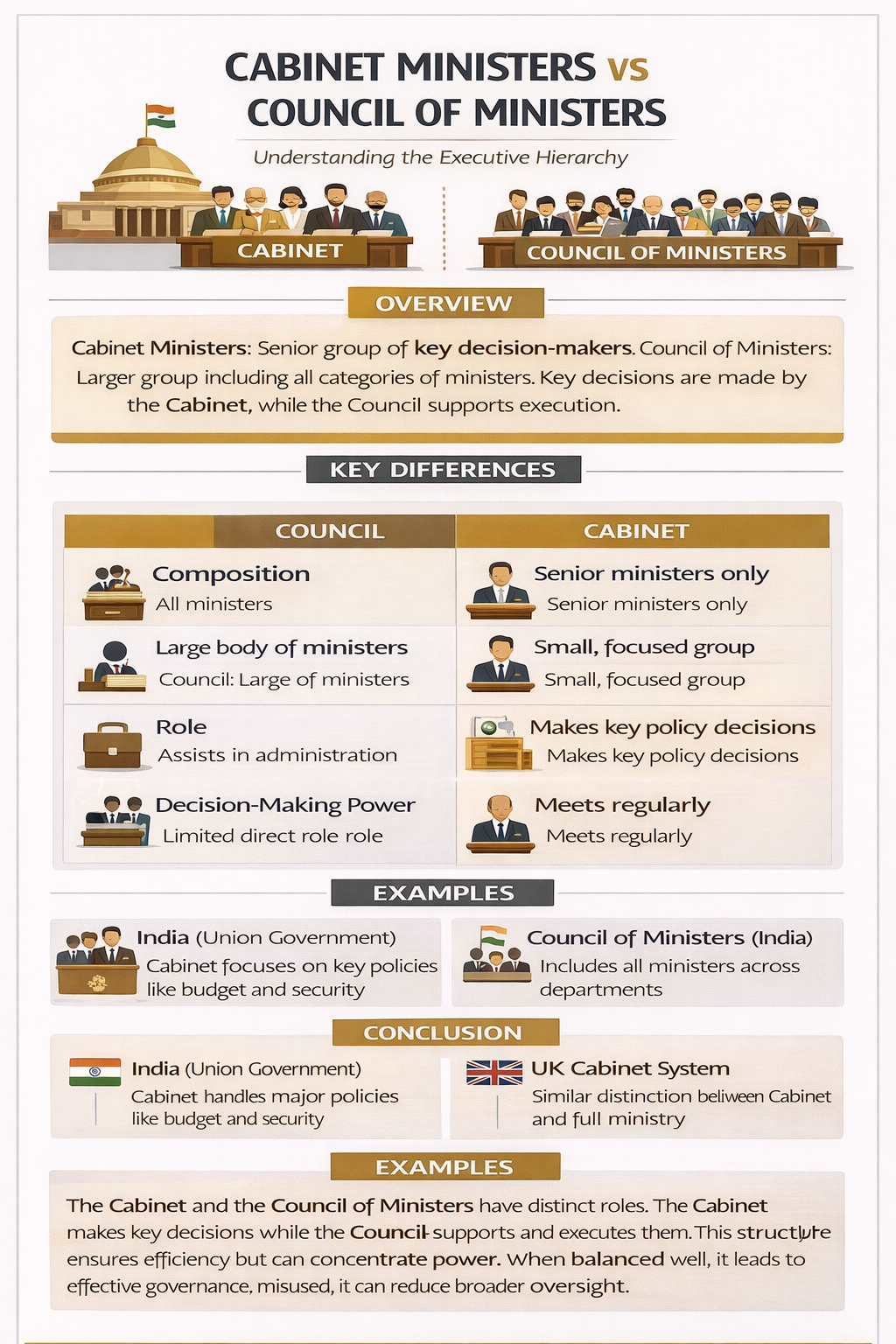
The Cabinet and the Council of Ministers are not the same. While the Council includes all ministers, the Cabinet is a smaller group of senior leaders who make key decisions. In practice, real executive power is concentrated within the Cabinet, not the entire council.

Overview
The Cabinet Ministers and the Council of Ministers are related but not the same. The Council of Ministers includes all categories of ministers in the government, while the Cabinet is a smaller group within it made up of senior ministers.The Cabinet is responsible for major policy decisions and governance direction, whereas the larger Council supports implementation and administration. This distinction is important because real decision-making authority lies primarily with the Cabinet.
Key Points
- Composition: Council – all ministers; Cabinet – senior ministers only
- Size: Council – large body; Cabinet – small and focused group
- Role: Council – assists in administration; Cabinet – makes key policy decisions
- Decision-Making Power: Council – limited role; Cabinet – core authority
- Meetings: Council – rarely meets as a whole; Cabinet – meets regularly
Legal Analysis
The Cabinet system improves efficiency by concentrating decision-making within a smaller group of senior ministers. This avoids delays that would arise if the entire Council were involved in every decision.However, this structure also concentrates power. Many ministers in the larger Council have limited influence over major decisions, which are largely controlled by the Cabinet.
In strong majority governments, this concentration can increase further, with significant authority centered around the Prime Minister and a few key Cabinet members.While the structure is practical for governance, it can reduce broader participation and internal checks if not balanced properly.
Examples
India (Union Government): The Cabinet handles major decisions such as the budget and national security policies.
Council of Ministers (India): Includes all ministers across departments who assist in administration and execution.
United Kingdom: Follows a similar distinction between the Cabinet and the full ministry.
Conclusion
The Cabinet and the Council of Ministers work together but perform different functions. The Cabinet serves as the core decision-making body, while the Council supports governance and execution.This structure ensures efficiency but also concentrates power within a smaller group. Its effectiveness depends on maintaining a balance between decisive leadership and broader participation.