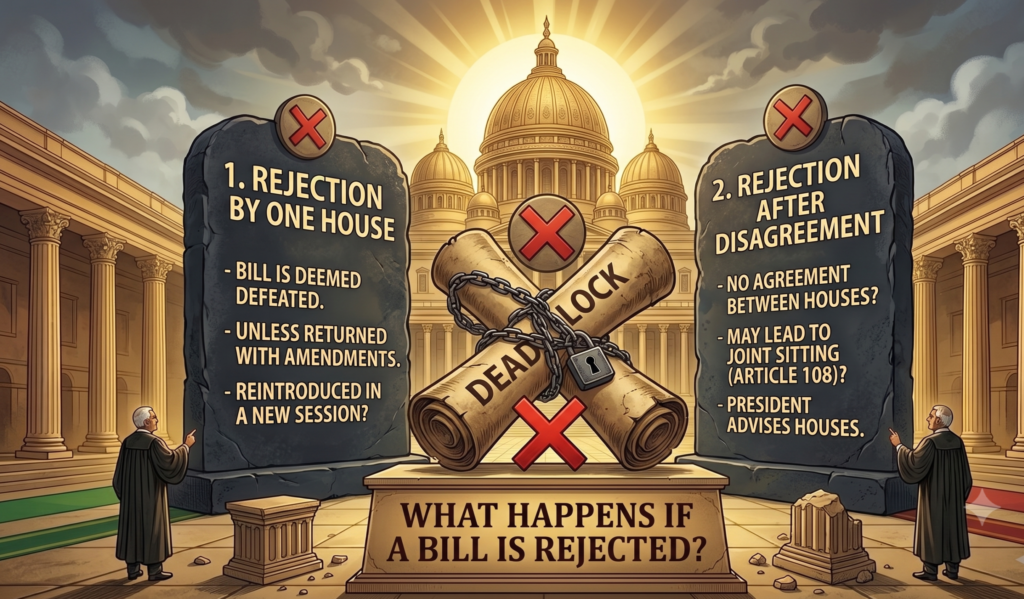
Under 17
What is a Joint Sitting?
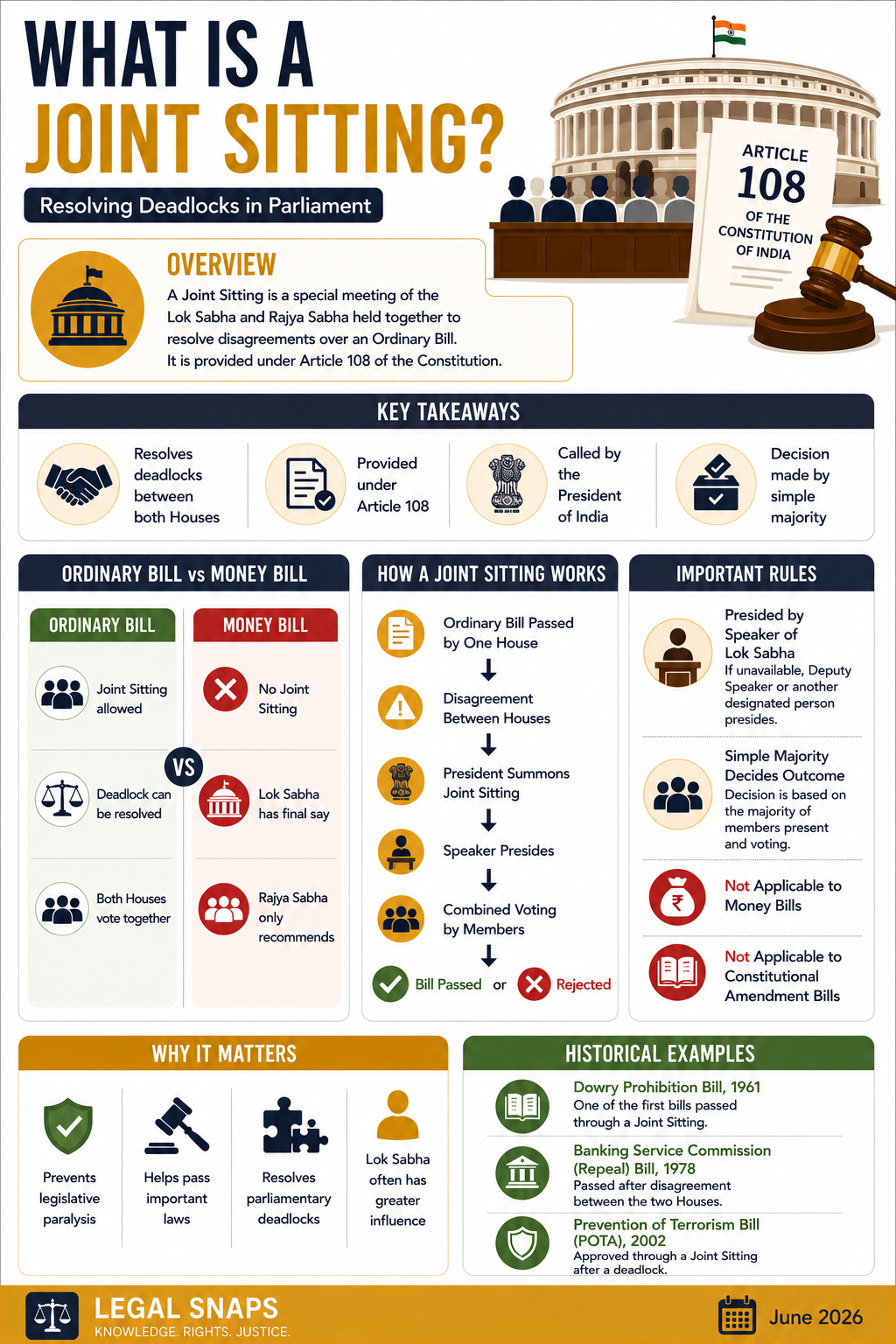
A Joint Sitting is a special constitutional mechanism used to resolve disagreements between the Lok Sabha and Rajya Sabha over an Ordinary Bill. It helps prevent legislative deadlocks and allows Parliament to complete the law-making process.

Overview
Under Article 108 of the Constitution, the President may summon a Joint Sitting when the two Houses of Parliament cannot agree on an Ordinary Bill.During a Joint Sitting, members of both Houses meet together, debate the bill, and vote as a single body. This ensures that important legislation is not indefinitely blocked due to parliamentary disagreement.
Key Points
- Article 108: Constitutional basis for Joint Sitting
- Purpose: Resolves deadlocks between the two Houses
- Called By: President of India
- Chaired By: Speaker of the Lok Sabha
- Voting: Simple majority of members present and voting
- Applies To: Ordinary Bills only
- Not Applicable: Money Bills and Constitutional Amendment Bills
Legal Analysis
The Joint Sitting mechanism balances legislative efficiency with democratic decision-making. It prevents important legislation from being permanently stalled due to disagreement between Lok Sabha and Rajya Sabha.Since Lok Sabha has significantly more members than Rajya Sabha, its position often carries greater weight during a Joint Sitting. This generally favors the House that directly represents the people.
However, the Constitution limits the use of Joint Sittings to Ordinary Bills only. Constitutional Amendment Bills and Money Bills follow separate procedures because of their special constitutional significance.As a result, Joint Sittings remain a rarely used but important constitutional tool for resolving parliamentary deadlocks.
Examples
Dowry Prohibition Bill, 1961: One of the earliest bills passed through a Joint Sitting.
Banking Service Commission (Repeal) Bill, 1978: Passed after disagreement between the two Houses.
Prevention of Terrorism Bill (POTA), 2002: Approved through a Joint Sitting following a legislative deadlock.
Conclusion
A Joint Sitting is an important constitutional mechanism that helps Parliament overcome legislative deadlocks and continue the law-making process.Although used only in limited circumstances, it ensures that disagreements between Lok Sabha and Rajya Sabha do not permanently block Ordinary Bills. By combining members of both Houses into a single voting body, it promotes legislative efficiency while preserving democratic accountability.
“`