Under 17
What is Public Interest Litigation (PIL)?
Public Interest Litigation (PIL) allows individuals and organizations to approach courts for matters affecting public welfare and constitutional rights. It has become a powerful tool for expanding access to justice and ensuring government accountability.

Overview
Public Interest Litigation (PIL) is a legal mechanism that enables any individual or organization to approach the courts to protect public interest or enforce the rights of disadvantaged groups.Unlike ordinary litigation, a PIL can be filed even by a person who is not directly affected by the issue. It helps ensure access to justice for vulnerable communities and addresses matters of broader public concern.
Key Points
- Public Welfare Focus: Protects public interest and addresses social issues
- Liberal Standing Rule: Any concerned citizen can file a PIL
- Protection of Rights: Safeguards Fundamental Rights and vulnerable groups
- Filed In: Supreme Court (Article 32) and High Courts (Article 226)
- Common Issues: Environment, human rights, governance, public health
- Judicial Activism: Courts can issue directions to authorities
Legal Analysis
Public Interest Litigation has significantly expanded access to justice by enabling courts to address issues affecting large sections of society. It has become a powerful instrument for protecting constitutional rights and promoting social justice.PILs have played an important role in environmental protection, prison reforms, women’s rights, child welfare, and government accountability. They have allowed courts to intervene where public authorities failed to act.
However, PILs can sometimes be misused for publicity, political agendas, or private interests disguised as public causes. Such misuse can burden courts and divert attention from genuine public concerns.To prevent abuse, courts carefully examine whether a petition genuinely serves public interest before admitting it for hearing.
Examples
M.C. Mehta Cases: PILs that led to major environmental protection measures across India.
Hussainara Khatoon Case (1979): Protected the rights of undertrial prisoners and promoted speedy justice.
Vishaka Case (1997): Led to landmark guidelines for preventing workplace sexual harassment.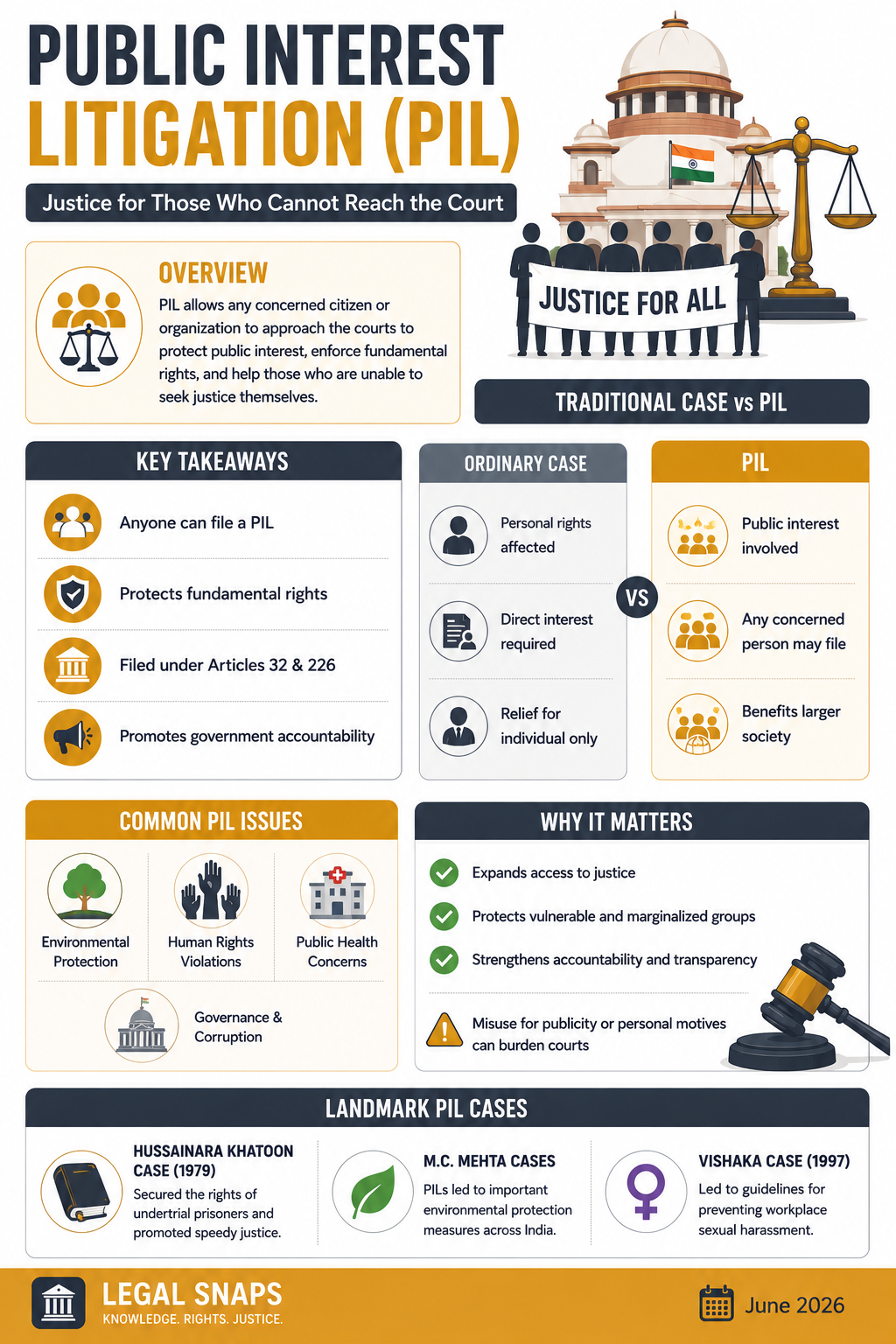
Conclusion
Public Interest Litigation is an important judicial innovation that strengthens democracy by making justice more accessible to the public.When used responsibly, PIL protects rights, promotes accountability, and addresses issues affecting society as a whole. Its effectiveness depends on ensuring that it remains a genuine tool for public welfare rather than a mechanism for private or political interests.
“`