Civil
Possession Is Key: Supreme Court Clarifies Hindu Succession Rights Under Section 14(1)
Overview The Supreme Court of India has reaffirmed a critical principle under Section 14(1) of the Hindu Succession Act, 1956 where a Hindu female is in possession of property, her limited right enlarges into absolute ownership.The Court clarified that possession is the determining factor. If property is possessed by a female Hindu under any pre-existing […]

Overview
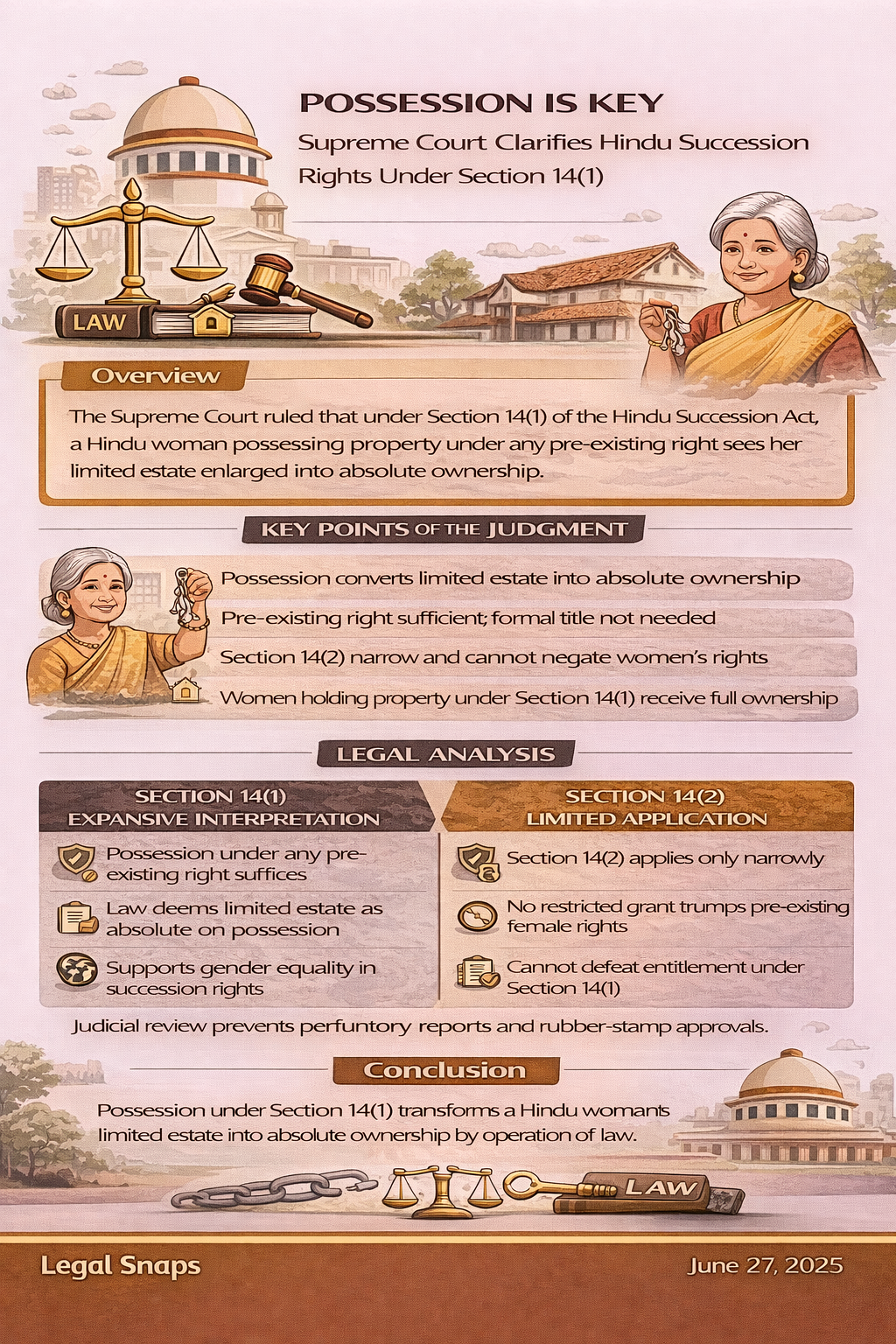
The Supreme Court of India has reaffirmed a critical principle under Section 14(1) of the Hindu Succession Act, 1956 where a Hindu female is in possession of property, her limited right enlarges into absolute ownership.The Court clarified that possession is the determining factor. If property is possessed by a female Hindu under any pre-existing right, even if described as “limited,” it becomes her absolute property by operation of law. This ruling strengthens women’s property rights and reinforces the legislative intent to eliminate gender-based limitations on ownership.
Key Points
- Possession triggers enlargement of ownership under Section 14(1).
- Limited estate converts into absolute ownership.
- Pre-existing right is sufficient; formal title not mandatory.
- Section 14(2) applies narrowly and cannot defeat women’s rights.
- Legislative intent favors full ownership for women.
Legal Analysis
Section 14(1) of the Hindu Succession Act represents a transformative provision aimed at abolishing the historical concept of a “limited estate” held by Hindu women. The Supreme Court reiterated that any property possessed by a female Hindu under a pre-existing legal right, whether acquired before or after the enactment of the Act, automatically enlarges into her absolute property. The term “possessed” is to be interpreted broadly, including lawful and constructive possession.
The Court drew a careful distinction between Section 14(1) and Section 14(2). While Section 14(2) applies when property is granted for the first time under a restrictive instrument, it cannot be invoked to dilute rights that already exist under law. Where a woman’s right flows from inheritance, maintenance, or any recognized pre-existing entitlement, Section 14(1) prevails and converts her limited interest into absolute ownership.
Importantly, the ruling emphasizes that technical deficiencies in documentation or absence of formal title do not defeat statutory enlargement if possession and pre-existing right are established. The legislative intent was to remove discriminatory constraints and confer full proprietary status upon women. Courts must therefore adopt a liberal and purposive interpretation consistent with gender justice.
By reaffirming this principle, the Supreme Court strengthened the constitutional commitment to equality in succession law. The judgment prevents restrictive interpretations that attempt to revive outdated limitations and ensures that women’s property rights are substantive, enforceable, and absolute.
Conclusion
The Supreme Court’s clarification under Section 14(1) decisively strengthens women’s inheritance and property rights. By holding that possession backed by a pre-existing right transforms limited ownership into absolute ownership, the Court reaffirmed the progressive spirit of the Hindu Succession Act.The ruling reinforces that statutory interpretation must align with the objective of eliminating gender-based property inequalities. Under Hindu succession law, possession is not incidental — it is decisive, and it operates as a powerful tool for securing full proprietary rights for women.