Crime
No Evidence of Forest Offence
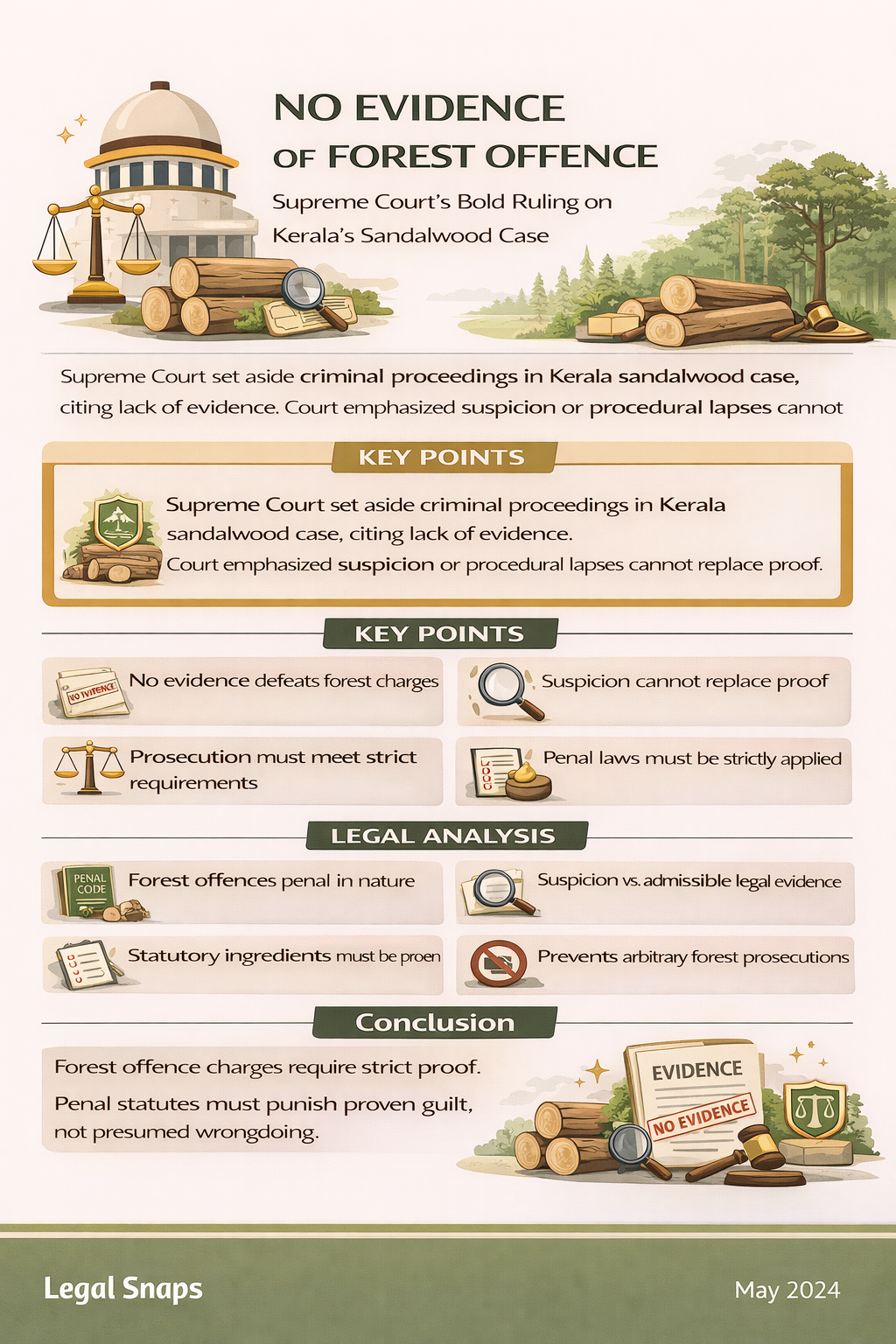
The Supreme Court has set aside criminal proceedings in Kerala’s sandalwood case, ruling that suspicion cannot replace proof in forest offence prosecutions.The Court held that penal liability requires strict proof of statutory ingredients.Mere recovery or allegation is insufficient to sustain conviction.Criminal law punishes proven guilt not presumed wrongdoing.

Overview
In a significant ruling, the Supreme Court of India set aside criminal proceedings in the alleged Kerala sandalwood offence case, holding that mere suspicion or procedural irregularities cannot substitute proof of a forest offence. The Court found that the prosecution failed to establish the essential statutory ingredients required under forest and wildlife laws. Criminal liability, the Court emphasized, cannot rest on assumptions or conjecture without concrete and legally admissible evidence.
Key Points
- Absence of evidence defeats forest offence charges.
- Mere recovery or allegation is insufficient.
- Prosecution must prove all statutory ingredients.
- Penal liability cannot be presumed.
- Proof beyond reasonable doubt remains mandatory.
Analysis
The Supreme Court reaffirmed that offences under forest and wildlife legislation are penal in nature and therefore require strict proof. Environmental statutes may serve important public objectives, but they do not dilute foundational criminal law principles. The prosecution must establish every statutory ingredient through credible evidence. Failure to prove foundational facts renders the entire prosecution unsustainable.
A critical distinction was drawn between suspicion and proof. However strong a suspicion may be, it cannot replace legally admissible evidence capable of sustaining conviction. Criminal trials are governed by the standard of proof beyond reasonable doubt. The Court warned against substituting procedural assumptions or incomplete investigation for substantive proof of guilt.
In the sandalwood case, the prosecution failed to establish illegal possession, conscious knowledge, and a direct nexus between the accused and the alleged forest produce. Mere recovery or procedural lapses were insufficient to fasten liability. The Court underscored that criminal culpability must be based on demonstrated involvement and intent, not inference alone.
Importantly, the judgment acts as a safeguard against arbitrary or overzealous enforcement. While forest conservation is a legitimate and vital state objective, environmental enforcement cannot bypass constitutional protections afforded to accused persons. Penal statutes must be applied with precision, not elasticity.
Conclusion
The Supreme Court’s ruling delivers a firm message: there can be no forest offence without proof of a forest offence. Penal consequences cannot arise from conjecture, suspicion, or incomplete investigation. Criminal law demands strict adherence to statutory requirements and evidentiary standards.By setting aside the prosecution, the Court has reinforced the rule of law, protected individual liberty, and clarified that environmental objectives must operate within constitutional and procedural boundaries. Criminal justice punishes proven guilt — not presumed wrongdoing.