Administrative
Acceptance Is Binding: Supreme Court Rules on Urban Planning Dispute
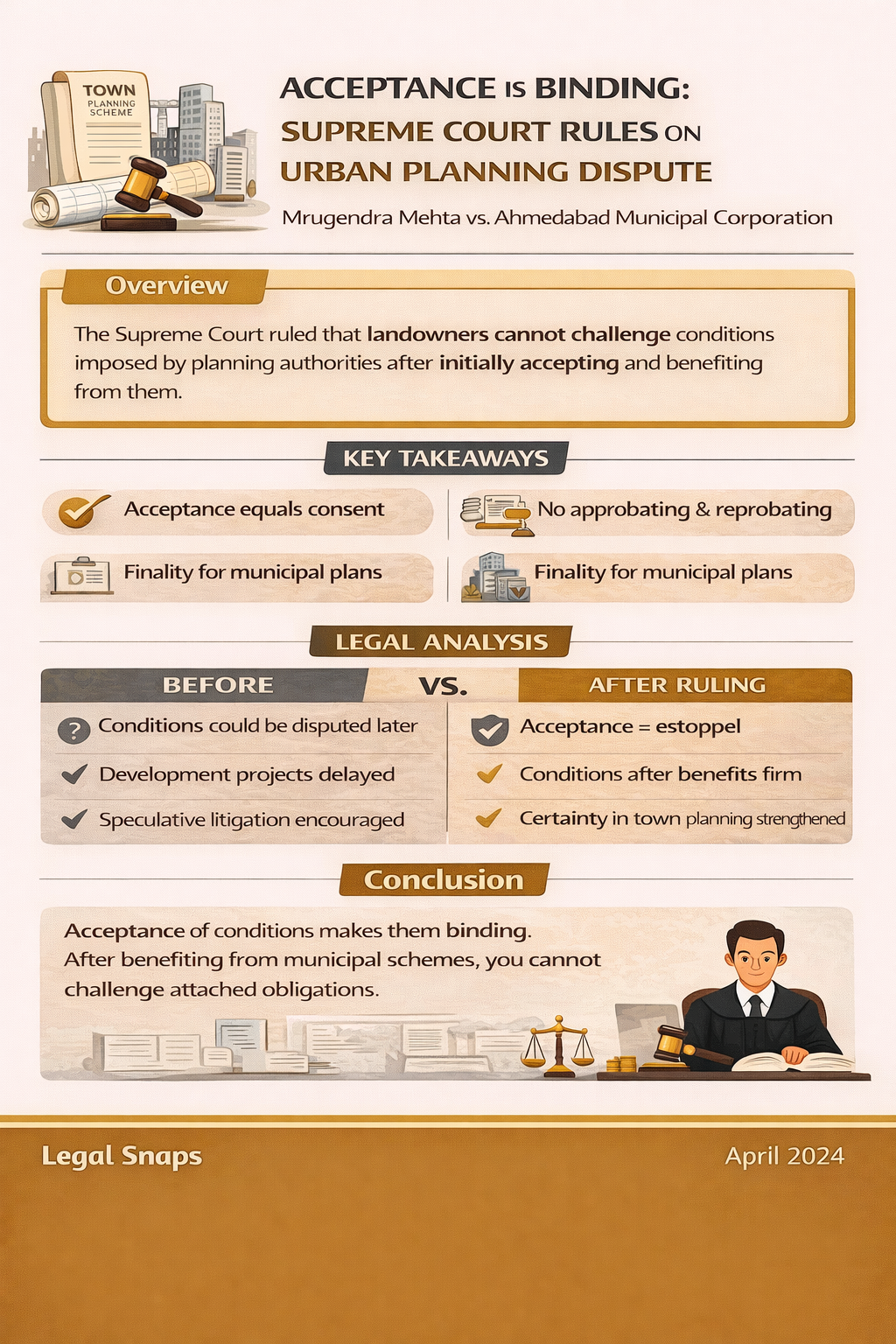
Once planning conditions are accepted, they become legally binding.A party cannot accept benefits and later challenge obligations.The Supreme Court reinforces estoppel in urban planning disputes.Acceptance brings finality to municipal decision-making.

Overview
In Mrugendra Mehta vs. Ahmedabad Municipal Corporation, the Supreme Court clarified that once a landowner or developer accepts the conditions imposed by a planning authority, such acceptance becomes binding. The ruling reinforces contractual certainty in town planning schemes and limits afterthought litigation once benefits under a scheme have been availed.
Key Points
- Acceptance of planning conditions creates binding consent.
- Parties cannot accept benefits and later challenge obligations.
- Municipal decisions gain finality once accepted.
- Post-acceptance challenges are legally untenable.
- Promotes certainty in urban development governance.
Analysis
The Court applied the doctrine of estoppel, holding that a party who knowingly accepts conditions under a planning scheme cannot later dispute them. Acceptance generates binding legal consequences and prevents inconsistent positions in subsequent litigation.
Town planning schemes function as integrated regulatory frameworks involving reciprocal rights and obligations. Selective acceptance of benefits while rejecting burdens would disrupt statutory balance and undermine structured urban development.
The principle against approbation and reprobation was reaffirmed. Once benefits such as reconstituted plots or development permissions are availed, attached conditions cannot be challenged as an afterthought.
The judgment enhances administrative certainty, reduces speculative litigation, and safeguards public interest in planned urban growth. Municipal authorities must be able to rely on the finality of accepted decisions.
Conclusion
The Supreme Court has firmly held that acceptance under a planning scheme is binding. Benefits cannot be retained while obligations are challenged. By reinforcing estoppel and administrative finality, the ruling strengthens fairness, predictability, and discipline in municipal governance.