Administrative
Supreme Court Upholds Democratic Integrity
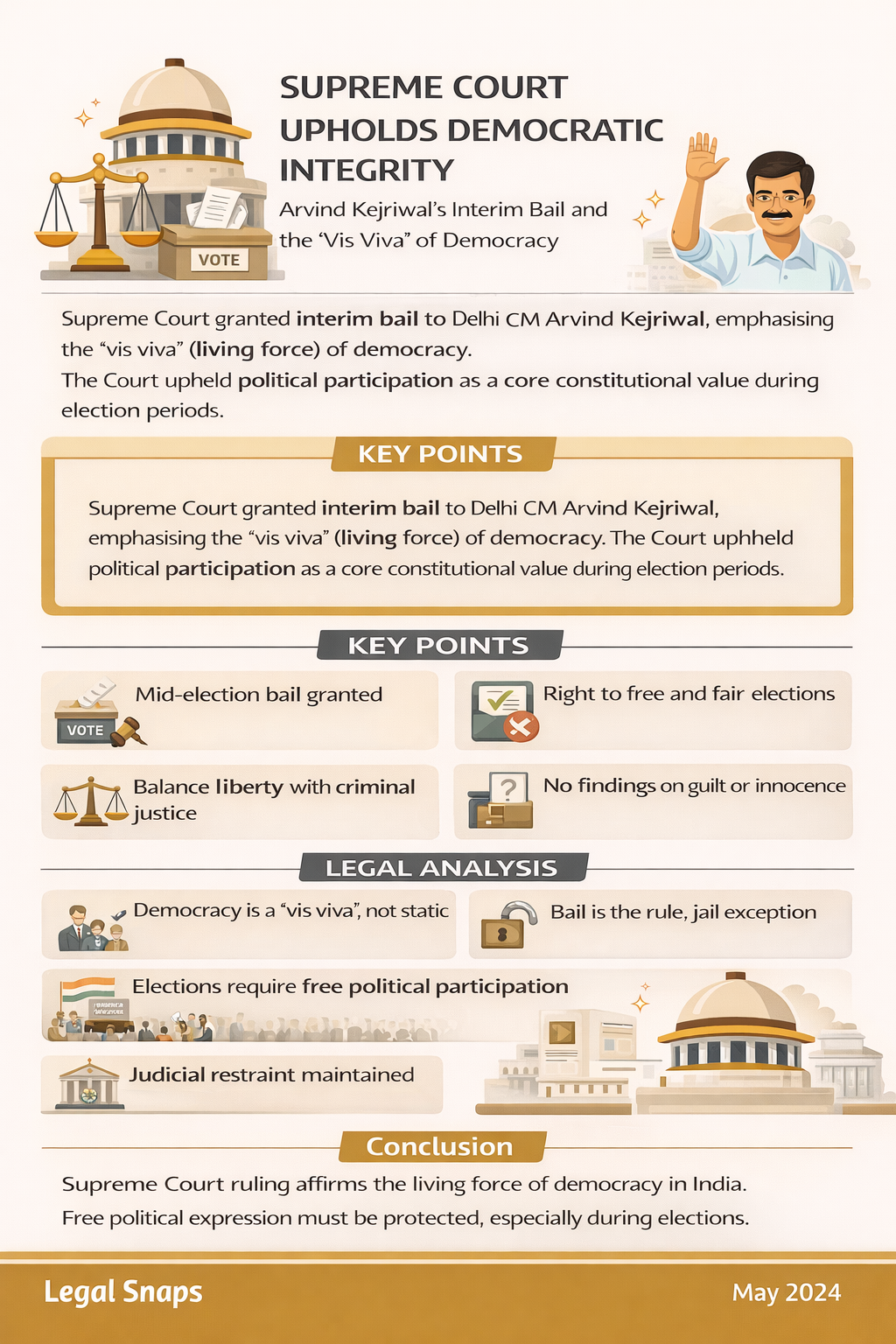
The Supreme Court granted interim bail during the election period, emphasizing the “vis viva” or living force of democracy. The Court balanced personal liberty with ongoing investigation. It clarified that the order does not reflect on guilt or innocence. The ruling reinforces constitutional protection of democratic participation.

Overview
In a significant constitutional moment, the Supreme Court of India granted interim bail to Delhi Chief Minister Arvind Kejriwal, emphasising the “vis viva” — the living force — of democracy. The Court recognised that in a representative system, free political participation and electoral engagement are core constitutional values.While refraining from expressing any view on the merits of the criminal case, the Court underlined that democratic processes and constitutional freedoms must be preserved alongside the interests of criminal justice.
Key Points
- Interim bail granted during election period.
- Democracy described as a living constitutional force.
- Political participation recognised as a constitutional value.
- Bail order not a comment on guilt or innocence.
- Balance maintained between liberty and investigation.
Analysis
The Supreme Court anchored its reasoning in constitutional principles rather than political considerations. By invoking the concept of “vis viva of democracy,” the Court emphasized that democratic governance depends on active participation and informed electoral engagement.
The judgment also reinforces settled bail jurisprudence under Article 21. Personal liberty cannot be curtailed mechanically, and interim bail may be granted depending on contextual factors. The Court balanced liberty with investigative necessity without prejudging the case.
The electoral context was treated as constitutionally relevant. In a representative democracy, voters have the right to assess political leadership during elections. Curtailing political participation without compelling necessity may affect democratic legitimacy.
At the same time, the Court exercised institutional restraint. It imposed conditions to ensure that investigation proceeds unhindered and avoided commenting on the merits. The ruling preserves separation of powers while safeguarding constitutional values.
Conclusion
The Supreme Court’s decision highlights that constitutional democracy must function in practice, especially during elections. By granting interim bail while safeguarding investigative integrity, the Court balanced liberty, democratic participation, and rule of law within the constitutional framework.