Administrative
Supreme Court Upholds Minimum Qualifying Marks for Viva Voce in Judicial Selections
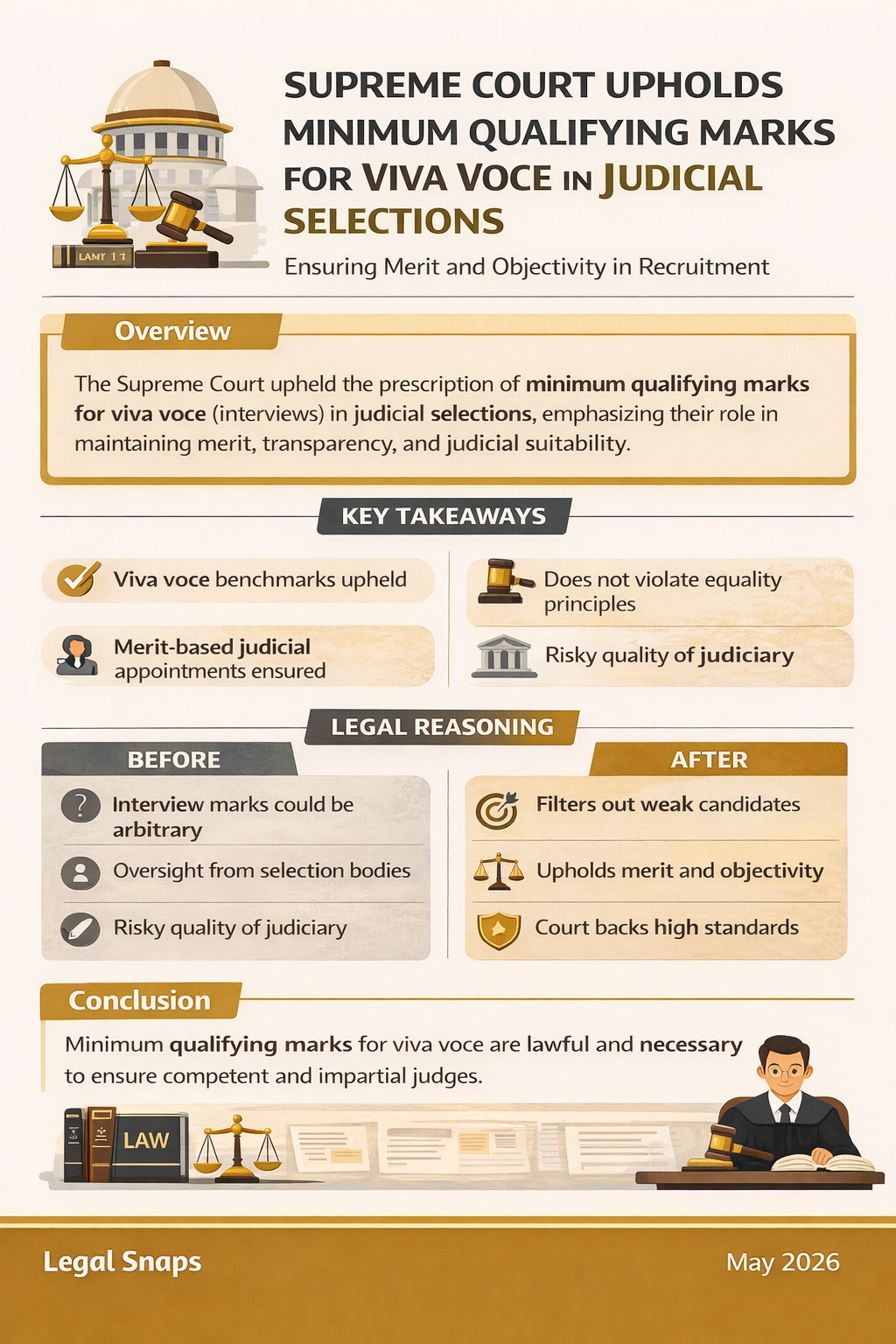
The Supreme Court has upheld minimum qualifying marks for viva voce in judicial recruitment. The Court ruled that interviews are essential to assess judicial temperament and suitability. Fixing cut-offs does not violate equality principles if applied uniformly. The judgment reinforces merit, transparency, and institutional integrity in judicial appointment

Overview
The Supreme Court of India has upheld the prescription of minimum qualifying marks for the viva voce stage in judicial selections, affirming that such benchmarks are essential to maintain merit, transparency, and objectivity in the recruitment of judges. The Court rejected challenges alleging arbitrariness and held that fixing minimum interview marks is a legitimate exercise of rule-making power, particularly where judicial temperament and suitability cannot be assessed through written examinations alone.
Key Points
- Minimum viva voce marks are constitutionally valid.
- Interview assesses judicial temperament and suitability.
- Uniform cut-offs do not violate Articles 14 and 16.
- Recruitment rules merit judicial deference.
- Courts should not substitute expert assessment bodies.
Analysis
The Supreme Court emphasized that judicial recruitment demands evaluation of qualities beyond academic knowledge. While written examinations assess legal proficiency, viva voce serves to measure communication skills, reasoning clarity, ethical disposition, and judicial temperament. These attributes are indispensable to the effective discharge of judicial functions.
The Court held that prescribing minimum qualifying marks in viva voce ensures baseline competence and prevents disproportionate reliance on written performance. Such standards promote objective assessment and eliminate arbitrariness. Provided the benchmark is reasonable and uniformly applied, it remains constitutionally sustainable.
Addressing equality concerns, the Court clarified that Articles 14 and 16 do not prohibit differential assessment methods. Equality requires uniform application of standards, not absence of standards. Merit-based exclusion resulting from failure to meet interview benchmarks does not constitute discrimination.
The judgment also reinforces deference to rule-making authorities, particularly High Courts exercising constitutional powers. Judicial interference is warranted only when recruitment norms are manifestly arbitrary or unconstitutional. In the absence of such infirmity, courts must respect institutional expertise in determining suitability standards.
Conclusion
The Supreme Court has firmly established that minimum qualifying marks for viva voce in judicial selections are lawful, rational, and necessary. By upholding these standards, the Court has reinforced merit-based recruitment, ensured transparency in assessment, and protected the long-term integrity and credibility of the judiciary.