Administrative
Non-Retroactivity of Rules in Ongoing Exams
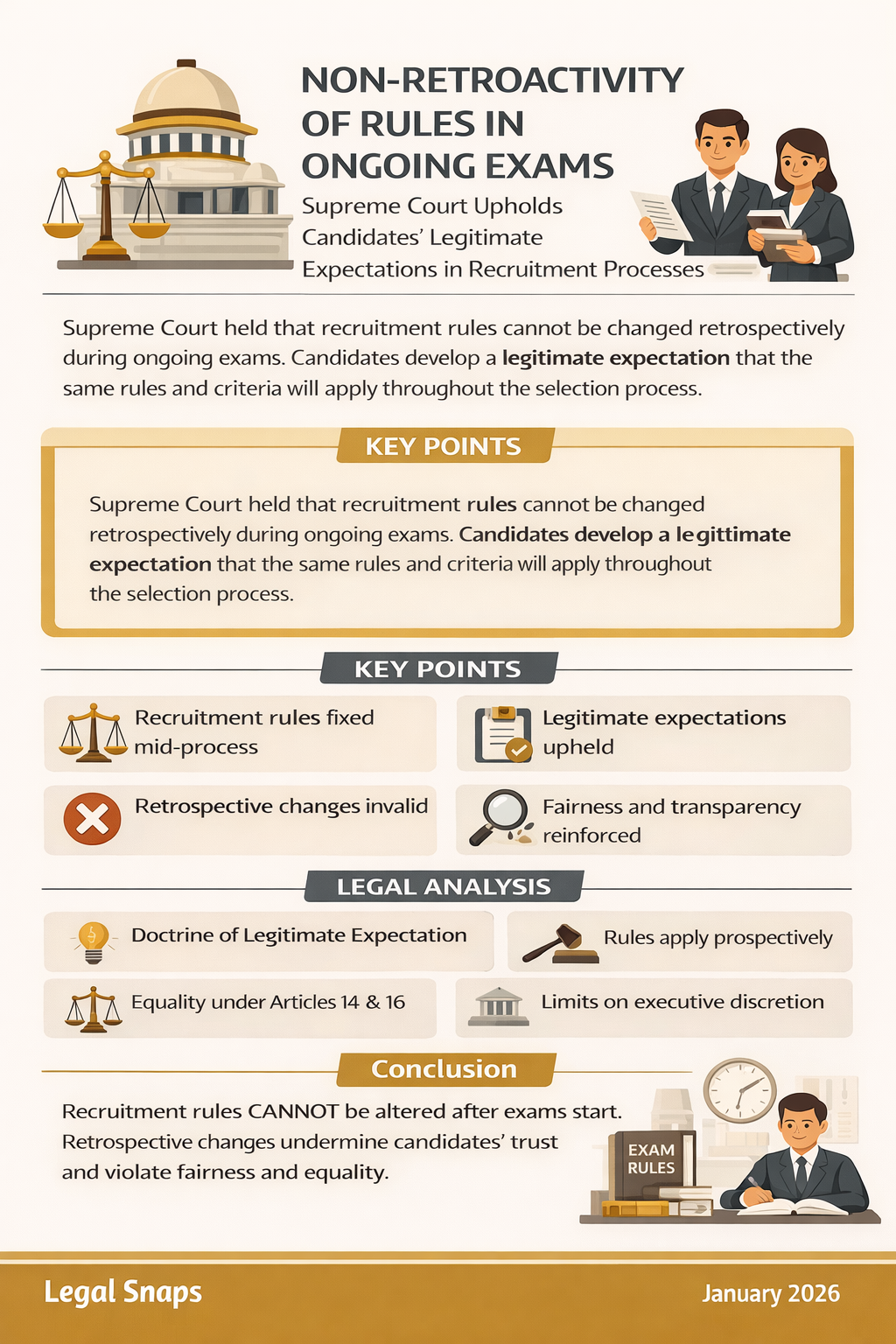
The Supreme Court has ruled that recruitment or examination rules cannot be changed once the selection process has begun. Candidates acquire a legitimate expectation that the notified rules will govern the entire process. Any midstream alteration in eligibility or evaluation norms is arbitrary and violates constitutional guarantees of fairness. The judgment reinforces transparency and stability in public employment

Overview
The Supreme Court of India has reaffirmed that recruitment or examination rules cannot be altered retrospectively once a selection process has commenced. Candidates acquire a legitimate expectation that the rules in force at the time of notification will govern the entire process. Any mid-stream change in eligibility, evaluation, or selection norms was held to be arbitrary unless expressly authorised by statute.
Key Points
- Recruitment rules cannot be changed mid-process.
- Candidates have legitimate expectation of rule stability.
- Retrospective application of amended rules is impermissible.
- Fairness and transparency govern public recruitment.
- Executive discretion is limited once the process begins.
Analysis
The Supreme Court’s ruling is grounded in the doctrine of legitimate expectation. Once a recruitment notification is issued and candidates apply under specified rules, they form a reasonable expectation that those rules will remain constant throughout the selection process. Altering eligibility criteria or evaluation norms mid-process defeats this expectation and introduces arbitrariness into what must remain a predictable administrative framework.
The Court reinforced the principle of non-retroactivity as a fundamental aspect of the rule of law. Legal norms affecting rights are presumed to operate prospectively unless clearly stated otherwise. Applying amended rules to an ongoing examination violates Article 14 and disrupts the competitive balance among candidates who prepared under earlier conditions.
From a constitutional perspective, the decision strengthens Articles 14 and 16 by preserving equality in public employment. Midway changes distort the level playing field and compromise transparency. Fair competition requires that all candidates be judged by the same standards that existed at the commencement of the process.
The judgment also places limits on administrative discretion. While the State may amend recruitment rules, such amendments must precede the initiation of the selection process. Policy convenience cannot override constitutional safeguards. Stability in procedure ensures institutional trust and protects candidates from arbitrary executive action.
Conclusion
The Supreme Court has firmly established that recruitment rules cannot be altered retrospectively during an ongoing examination or selection process. Candidates are entitled to rely on the rules prevailing at the time of notification, and any deviation undermines fairness and equality. By upholding legitimate expectation and non-retroactivity, the Court has reinforced constitutional discipline in public recruitment and ensured that the State must adhere to its own prescribed norms.