Crime
Analysing the Supreme Court’s Verdict in Alauddin & Ors. v. State of Assam & Anr
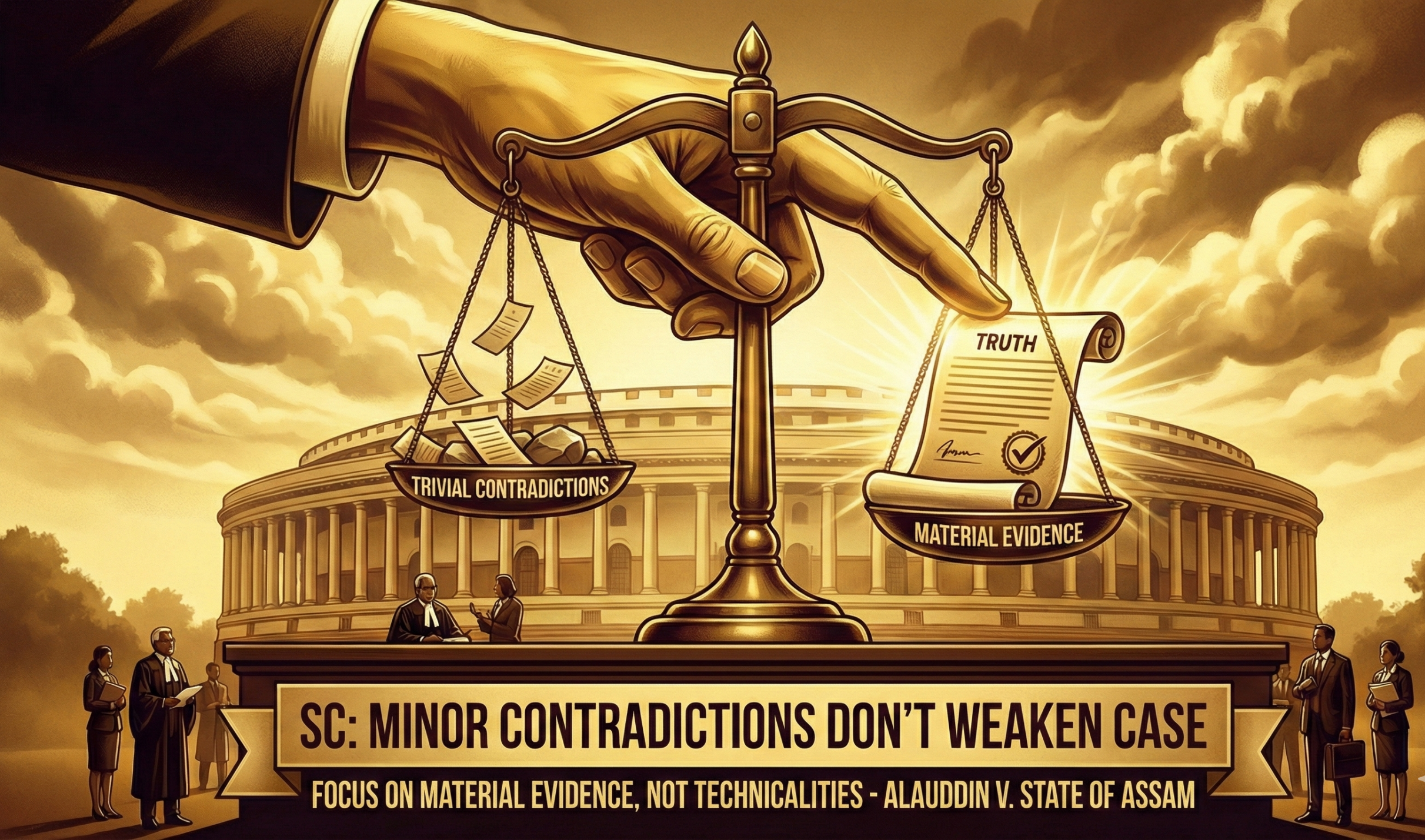
he Supreme Court in Alauddin & Ors. v. State of Assam & Anr. clarified that minor contradictions in witness testimony do not automatically weaken a criminal case. The Court distinguished between material inconsistencies and trivial discrepancies. It emphasized holistic evaluation of evidence rather than hyper-technical scrutiny. The ruling reinforces realistic evidentiary standards in criminal trials.
Overview
In Alauddin & Ors. v. State of Assam & Anr., the Supreme Court reaffirmed a settled but often misapplied principle of criminal jurisprudence: minor contradictions or omissions in witness testimony do not automatically render the prosecution case unreliable.The Court cautioned against an overly technical approach to evidence appreciation and emphasized that criminal trials must focus on the core truth of the prosecution case rather than insignificant discrepancies arising from human fallibility.
Key Points
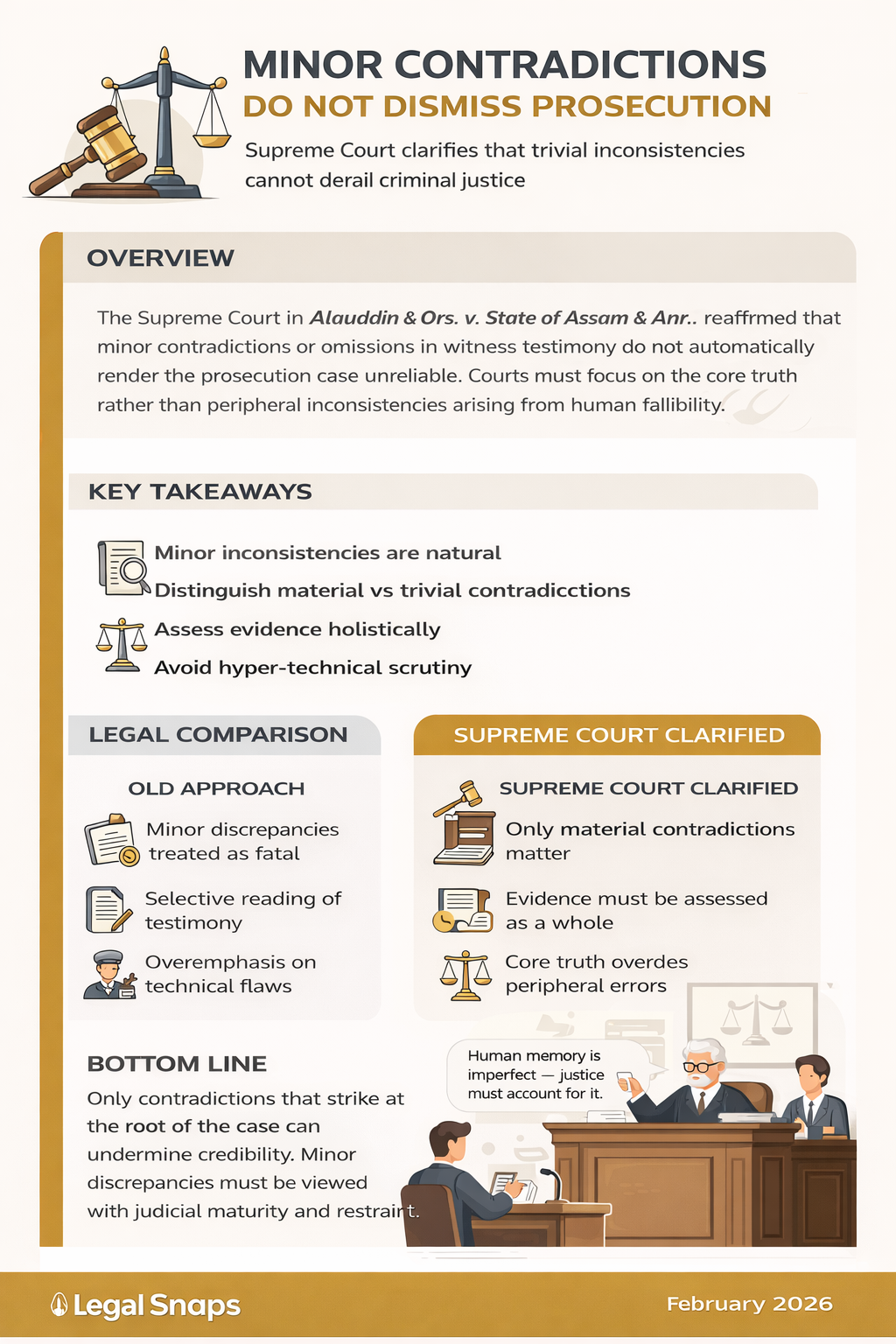
- Minor contradictions or omissions are natural.
- Courts must distinguish material vs trivial inconsistencies.
- Evidence must be assessed as a whole.
- Hyper-technical scrutiny undermines justice.
- Credible testimony cannot be discarded for peripheral errors.
Analysis
The Supreme Court began by acknowledging a fundamental reality of criminal trials: human testimony is not mechanically precise. Witnesses recount events after time gaps, interpret facts through individual perception, and express themselves differently under courtroom pressure. Minor inconsistencies are therefore natural consequences of human memory and narration. Treating such discrepancies as indicators of fabrication would impose an unrealistic standard of perfection on witnesses and undermine the administration of criminal justice.
The Court drew a clear distinction between material and trivial contradictions. Material contradictions are those that strike at the core of the prosecution case — altering the essential narrative of how the offence occurred or who committed it. Trivial inconsistencies, on the other hand, relate to peripheral details and do not affect the substance of the testimony. Only contradictions that materially weaken the prosecution’s case can justify discarding a witness’s credibility.
Reinforcing the principle of holistic appreciation of evidence, the Court emphasized that testimony must be evaluated in its entirety rather than dissected into isolated fragments. Selective reading to highlight minor inconsistencies distorts the evidentiary picture and risks miscarriage of justice. The real inquiry is whether the core version of events remains consistent and trustworthy.
At the same time, the Court maintained the constitutional balance between the accused’s right to a fair trial under Article 21 and society’s interest in effective prosecution. Criminal jurisprudence demands rigorous scrutiny of evidence, but not unattainable perfection. Excessive technicality can defeat justice just as surely as uncritical acceptance of flawed evidence.
Conclusion
The Supreme Court’s verdict firmly reiterates that every contradiction or omission is not a ground to discredit the prosecution case. Only inconsistencies that strike at the root of the matter and materially affect credibility can undermine a conviction. Minor discrepancies must be approached with judicial maturity and contextual understanding. By discouraging hyper-technical evaluation and encouraging holistic assessment, the judgment ensures that justice is guided by substance rather than superficial inconsistencies.