Civil
Welfare of the Minor Children is the Paramount Consideration
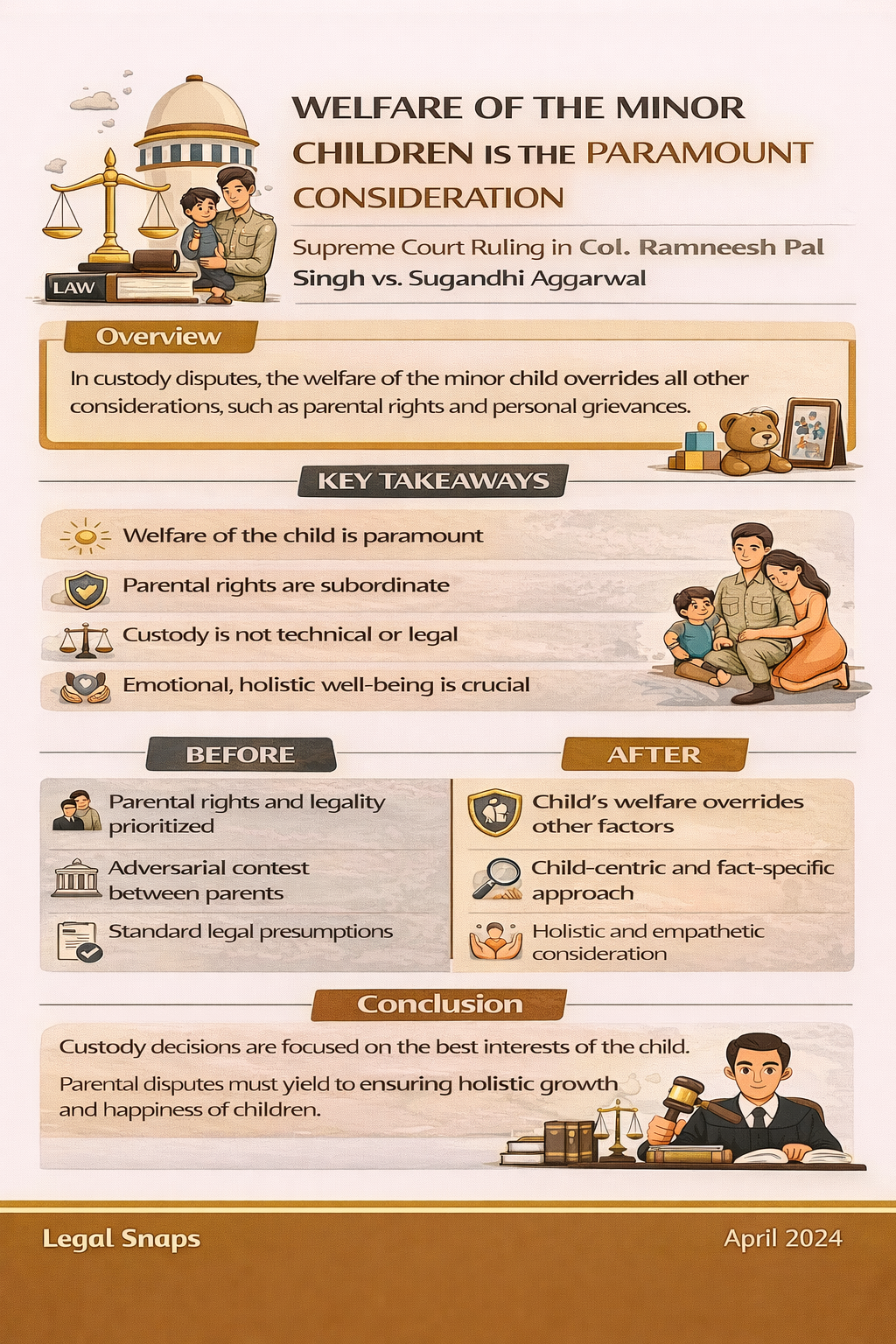
Welfare of the child overrides parental rights.Custody is determined by best interests, not entitlement.Emotional and psychological well-being are central.Courts adopt a child-centric, not parent-centric, approach.

Overview
In Col. Ramneesh Pal Singh v. Sugandhi Aggarwal, the Supreme Court reaffirmed that the welfare of the minor child is the paramount consideration in custody disputes. Parental rights, statutory presumptions, or personal grievances cannot override the child’s physical, emotional, psychological, moral, and educational well-being. Custody decisions must be guided by what truly serves the child’s holistic interests.
Key Points
- Welfare of the child is the overriding legal test.
- Parental rights are subordinate to best interests.
- Financial strength alone is not decisive.
- Custody is a responsibility, not a proprietary right.
- Each case must be decided on its unique facts.
Analysis
The Supreme Court placed the doctrine of paramount welfare at the centre of custody jurisprudence. Custody disputes are not adversarial contests where parental rights are weighed mechanically. They involve the future of a minor whose emotional development, psychological security, and long-term stability are at stake. Statutory presumptions under personal or guardianship laws must yield to the overarching test of what practically and realistically serves the child’s best interests.
The Court clarified that “welfare” is a broad and holistic concept. It extends beyond material comfort or financial superiority to include emotional bonding, continuity of education, moral upbringing, mental health, and stability of environment. Courts must assess the totality of circumstances — including the child’s age, existing social setting, educational continuity, and overall developmental needs. Welfare is not transactional; it is comprehensive.
Significantly, parental rights were described as subordinate to child welfare. Custody is not a proprietary claim arising from biological connection. Even a natural guardian may be denied custody if the child’s happiness and growth would be better protected elsewhere. Guardianship is a fiduciary responsibility imposed by law — not an enforceable personal entitlement.
The Court also emphasized the need for judicial sensitivity. Prolonged litigation, frequent custody transfers, and parental hostility can themselves harm a child’s psychological well-being. Stability and continuity are vital components of welfare. Courts must avoid disruptive orders unless clearly necessary, ensuring that the child grows in a secure, nurturing, and predictable environment.
Conclusion
The Supreme Court’s decision in Col. Ramneesh Pal Singh v. Sugandhi Aggarwal reinforces that child welfare overrides all competing considerations in custody disputes. By subordinating parental claims to the child’s holistic well-being, the Court has strengthened the humane core of family law. Custody is not about asserting rights but about discharging responsibility in the best interests of a vulnerable individual.Financial capacity, statutory entitlement, or emotional claims cannot eclipse a child’s need for stability, affection, and psychological security. The ruling affirms that custody is a trust, not a trophy — and the welfare of the child remains the supreme law.