Administrative
The Public Examinations (Prevention of Unfair Means) Act, 2024
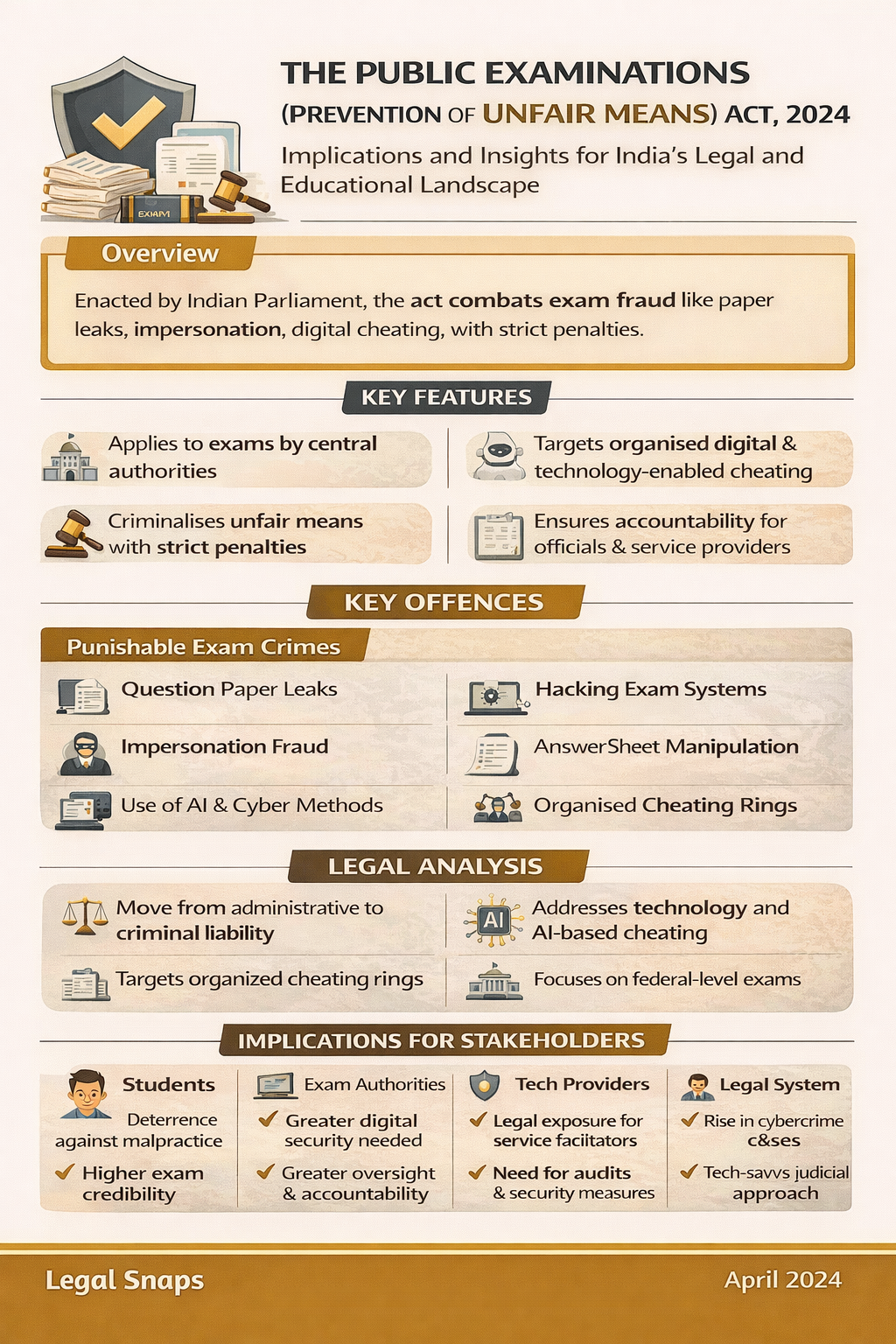
The Public Examinations (Prevention of Unfair Means) Act, 2024 criminalises organized and technology-driven exam fraud. It introduces stringent penalties for question paper leaks, impersonation, and digital manipulation. The law expands liability to intermediaries and service providers. The Act strengthens meritocracy and restores integrity in public examinations.

Overview
The Public Examinations (Prevention of Unfair Means) Act, 2024 marks a significant legislative response to recurring incidents of question paper leaks, impersonation, and technology-enabled cheating in public examinations. The Act seeks to protect the integrity, credibility, and fairness of recruitment and admission processes conducted by central authorities.By introducing criminal liability, stringent penalties, and institutional accountability, the law reflects a zero-tolerance approach toward examination fraud and reinforces merit-based public systems.
Key Features
- Applies to examinations conducted by central authorities.
- Criminalises digital and organised unfair means.
- Imposes imprisonment and monetary penalties.
- Covers candidates, officials, intermediaries, and service providers.
- Punishes attempt, abetment, and conspiracy.
- Focuses on prevention, deterrence, and accountability.
Legal Analysis
The Act marks a shift from administrative penalties to criminal accountability. Examination malpractice is now treated as a public wrong affecting governance and equal opportunity. By introducing custodial sentences and fines, Parliament elevates examination integrity to a matter of national importance.
The legislation addresses technology-enabled cheating, including hacking, AI-based impersonation, and digital manipulation of records. It aligns examination governance with cybercrime jurisprudence, recognising that modern fraud ecosystems operate digitally and at scale.
By extending liability to intermediaries and organised networks, the Act targets systemic fraud rather than isolated offenders. Service providers, facilitators, and conspirators are brought within the legal framework, closing long-standing enforcement gaps.
Despite its stringent approach, the Act preserves due process safeguards. Criminal liability requires proof of intent or knowledge, ensuring that enforcement remains consistent with constitutional protections and principles of fairness.
Conclusion
The Public Examinations (Prevention of Unfair Means) Act, 2024 represents a structural reform in safeguarding meritocracy and public trust. By criminalising organized and technology-driven exam fraud, the Act reinforces accountability and compels institutions to modernise security frameworks. In an era where examinations determine careers and opportunities, integrity is foundational. This law transforms examination fraud from misconduct into a criminal offence against public confidence, strengthening governance and protecting genuine candidates.