Administrative
The Cancellation of Dealership Agreement is a Serious Business Supreme Court of India in HPCL v. Dharamnath Singh
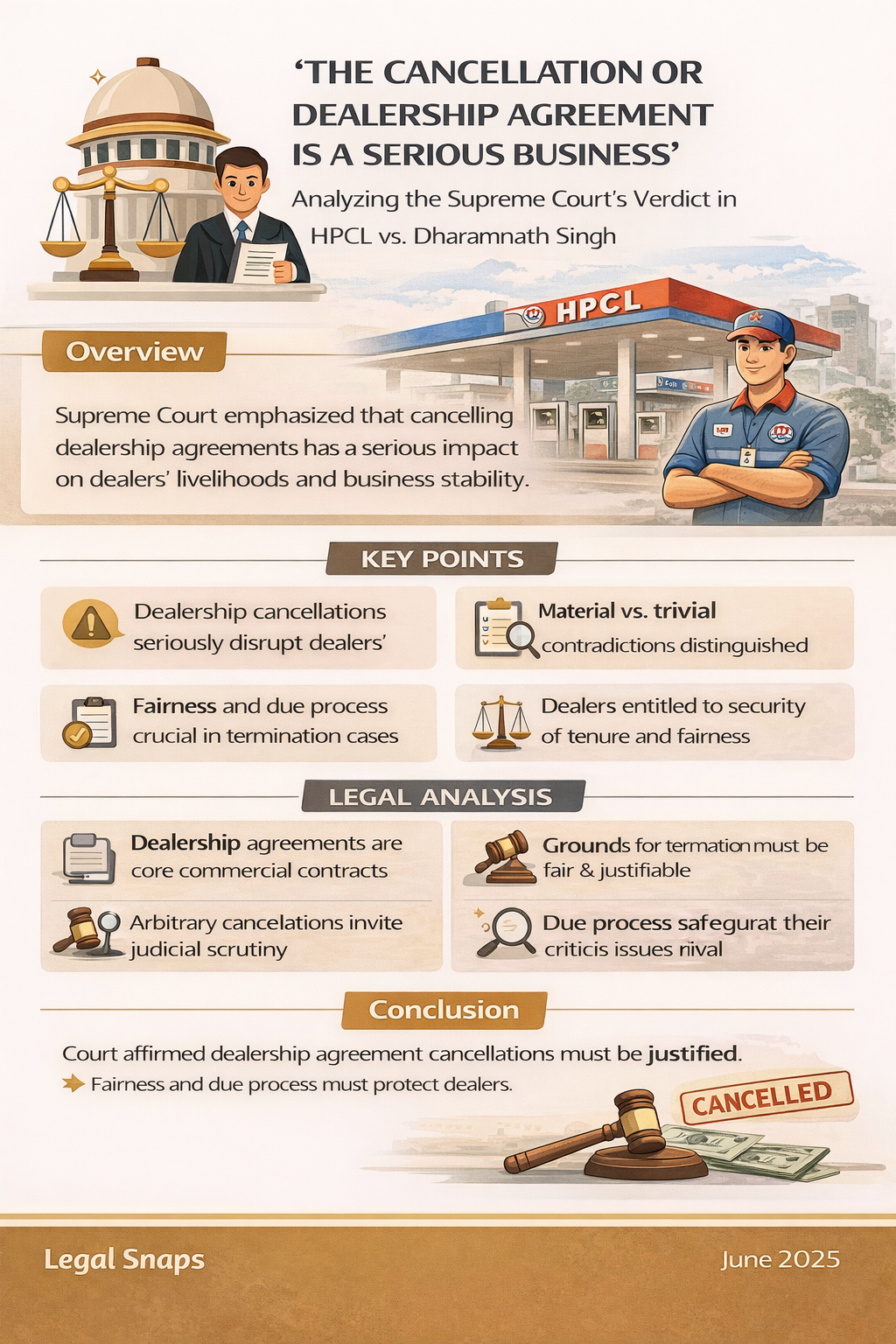
The Supreme Court held that cancellation of dealership agreements is a serious commercial action.Termination must strictly follow contractual terms and natural justice.Arbitrary cancellation invites judicial scrutiny.Dealership termination demands fairness, evidence, and proportionality.

Overview
In Hindustan Petroleum Corporation Ltd. (HPCL) v. Dharamnath Singh, the Supreme Court of India emphasized that cancellation of dealership agreements is not a routine administrative act but a serious commercial decision with significant economic consequences.The Court observed that dealership agreements directly affect livelihood, reputation, and financial stability. Termination must therefore be based on fair, reasonable, and legally sustainable grounds, strictly in accordance with contractual terms and principles of natural justice.
Key Takeaways
- Cancellation of dealership agreements has serious economic impact.
- Termination must strictly follow contractual provisions.
- Fairness and due process are mandatory safeguards.
- Arbitrary or mechanical cancellation invites judicial review.
- Dealers are entitled to opportunity of hearing.
Legal Analysis
The Supreme Court recognized that dealership agreements are core commercial contracts forming the economic backbone of small entrepreneurs. These are not casual arrangements but structured long-term engagements governed by regulatory frameworks and contractual discipline. Terminating such arrangements impacts livelihood and business continuity, and therefore demands heightened legal scrutiny.
The Court held that termination must rest on clearly established grounds supported by material evidence. Allegations cannot be vague, speculative, or unsupported. Minor or technical breaches cannot justify disproportionate punishment. Administrative discretion must operate within the bounds of proportionality and reasonableness.
Reinforcing principles of natural justice, the Court emphasized the necessity of prior notice, opportunity to respond, and fair consideration of explanations. A dealer cannot be condemned without due process. Mechanical or pre-determined decisions violate fundamental fairness embedded in contractual governance.
The judgment also clarified that judicial review is available where cancellation is arbitrary, procedurally flawed, mala fide, or disproportionate. Courts act as constitutional safeguards against misuse of contractual power by public sector corporations, ensuring accountability and commercial justice.
Conclusion
The Supreme Court’s ruling firmly establishes that dealership termination is a serious commercial action, not a routine administrative measure. By insisting on contractual compliance, proportionality, and procedural fairness, the Court strengthened commercial stability and protected livelihood interests.Dealership agreements affect economic survival — their cancellation demands strict legal rigor, not administrative convenience.