Administrative
Legal Profession Is Sui Generis
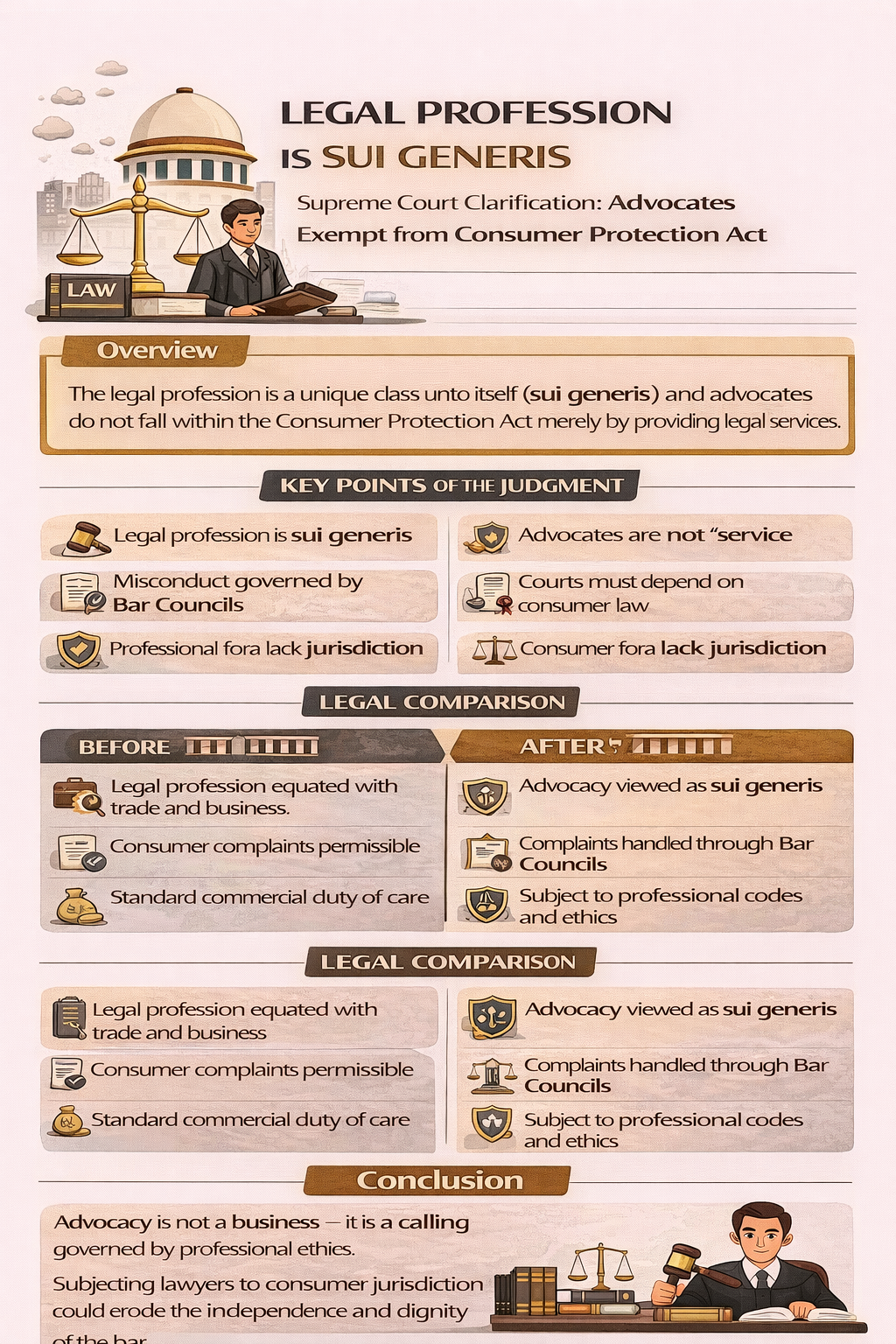
The Supreme Court has held that the legal profession is sui generis and not covered under the Consumer Protection Act.Advocates cannot be treated as ordinary service providers for professional conduct.Complaints against lawyers must be addressed under the Advocates Act through Bar Councils.The ruling safeguards the independence and institutional integrity of the legal profession.

Overview
The Supreme Court of India has categorically held that the legal profession is sui generis—a class of its own—and advocates do not fall within the ambit of the Consumer Protection Act merely by rendering professional legal services. The Court emphasized that advocacy is not a commercial or business activity but a profession governed by ethical standards, statutory regulation, and disciplinary control under the Advocates Act, 1961.Subjecting advocates to consumer jurisdiction, the Court warned, would undermine the independence, dignity, and institutional role of the legal profession in the administration of justice.
Key Points
- Legal profession is sui generis, not a trade or business.
- Advocates are not “service providers” under consumer law.
- Lawyer–client relationship is fiduciary, not commercial.
- Professional misconduct governed by the Advocates Act.
- Consumer fora lack jurisdiction over legal services.
Analysis
By describing the legal profession as sui generis, the Supreme Court underscored its unique constitutional character. Advocacy is not merely fee-based service delivery; it is an institutional function integral to the justice system. A lawyer’s primary duty is to the court and the cause of justice, not merely to the client. This structural role differentiates advocates from ordinary commercial service providers.
The Court clarified that the Consumer Protection Act is designed to regulate commercial and business services. Legal representation, however, involves professional judgment, strategic discretion, and ethical responsibility. Outcomes depend on judicial determination and procedural dynamics—factors beyond a lawyer’s control. Imposing consumer standards on such services risks misunderstanding the nature of advocacy.
Rejecting the argument that payment of fees creates a consumer relationship, the Court held that the lawyer–client bond is fiduciary in nature. It is built on trust, confidentiality, and professional independence. Reducing it to a buyer–seller transaction would erode professional autonomy and distort the ethical framework governing legal practice.
Importantly, the Court emphasized that the Advocates Act, 1961 provides a complete and self-contained disciplinary mechanism through Bar Councils. Allowing parallel consumer proceedings would create regulatory conflict and undermine the statutory scheme. Accountability must be ensured—but through the mechanism specifically designed for the legal profession.
Conclusion
The Supreme Court’s ruling firmly establishes that the legal profession occupies a unique constitutional space and cannot be treated as a commercial enterprise under the Consumer Protection Act. Advocates are accountablebut through the disciplinary framework of the Advocates Act, not consumer fora.By safeguarding the institutional independence and ethical integrity of the Bar, the Court has reinforced a foundational principle of the justice system: advocacy is a profession rooted in duty to law and court, not a commodity governed by consumer metrics.