Civil
Entertaining an Application Filed by a Stranger is Totally Unsustainable in Law
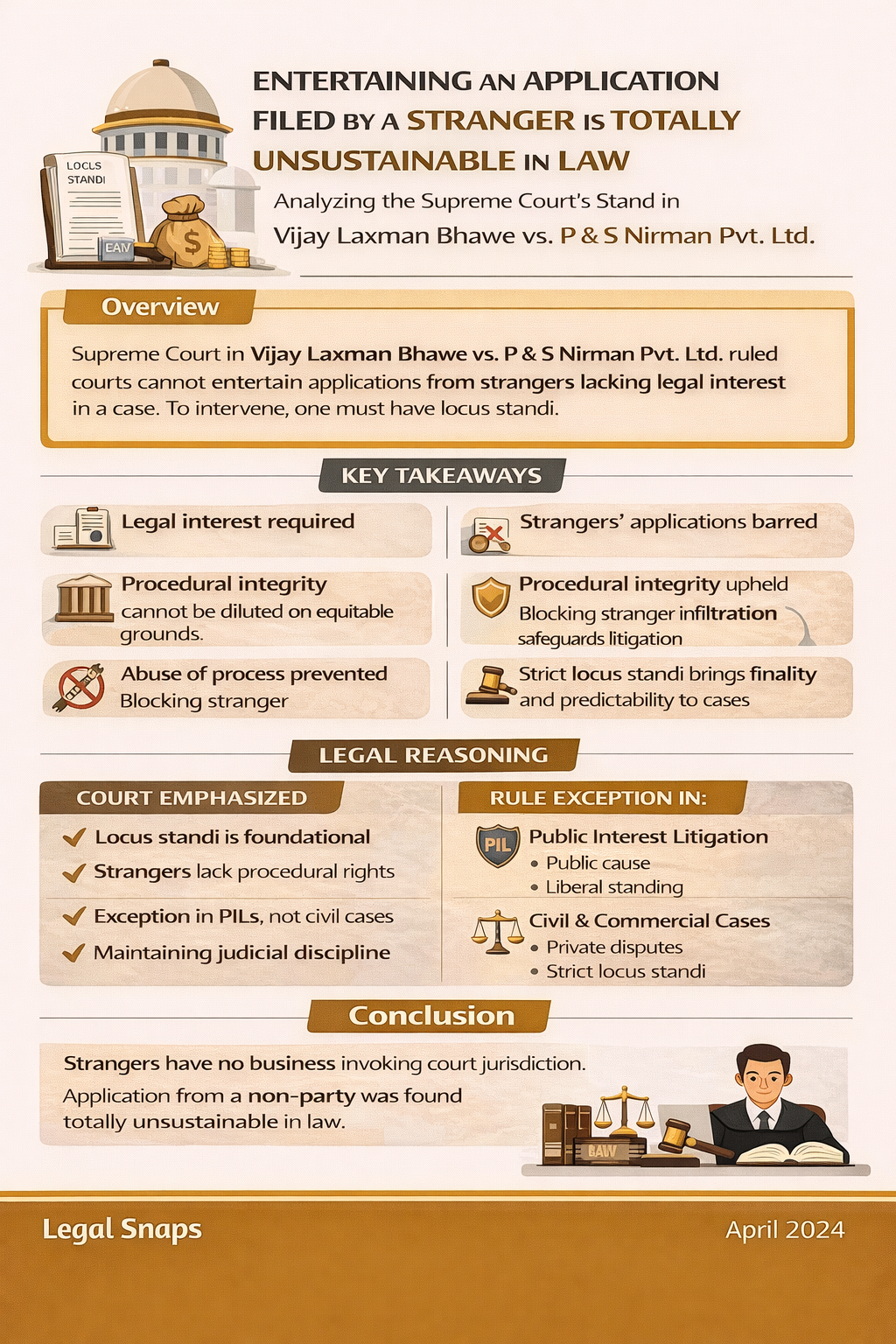
The Supreme Court reinforces strict locus standi in civil proceedings.Strangers to litigation cannot file applications in private disputes.Procedural discipline cannot be diluted on equitable grounds.Courts are not open forums for indirect or proxy intervention.

Overview
In Vijay Laxman Bhawe vs. P & S Nirman Pvt. Ltd., the Supreme Court held that courts cannot entertain applications filed by persons who are strangers to proceedings and have no legally recognizable interest in the dispute. The ruling reinforces foundational principles of locus standi and procedural discipline, emphasizing that litigation must remain confined to legally affected parties.
Key Points
- Only persons with direct legal interest may approach the court.
- Applications by strangers are legally unsustainable.
- Procedural law cannot be diluted on equitable grounds.
- Third-party interference undermines judicial discipline.
- Locus standi is a jurisdictional threshold requirement.
Analysis
The doctrine of locus standi requires that a party demonstrate direct and substantial legal interest before invoking court jurisdiction. Indirect or speculative interests do not confer standing.
Strangers to proceedings possess no procedural rights within a private dispute. Entertaining such applications constitutes jurisdictional error and disrupts adjudicatory discipline.
The Court distinguished private civil disputes from Public Interest Litigation, where liberal standing may apply. Strict locus standi governs commercial and contractual matters.
By preventing third-party interference, the judgment protects finality, avoids proxy litigation, and strengthens predictability in civil proceedings.
Conclusion
The Supreme Court has reaffirmed that courts are not open forums for strangers to intervene in private disputes. Locus standi remains a strict and essential requirement. Unless a person is directly and legally affected, they cannot invoke judicial jurisdiction. The ruling preserves procedural integrity and guards against abuse of process.