Civil
Arbitral Tribunal Must Decide in Accordance with Contract Terms
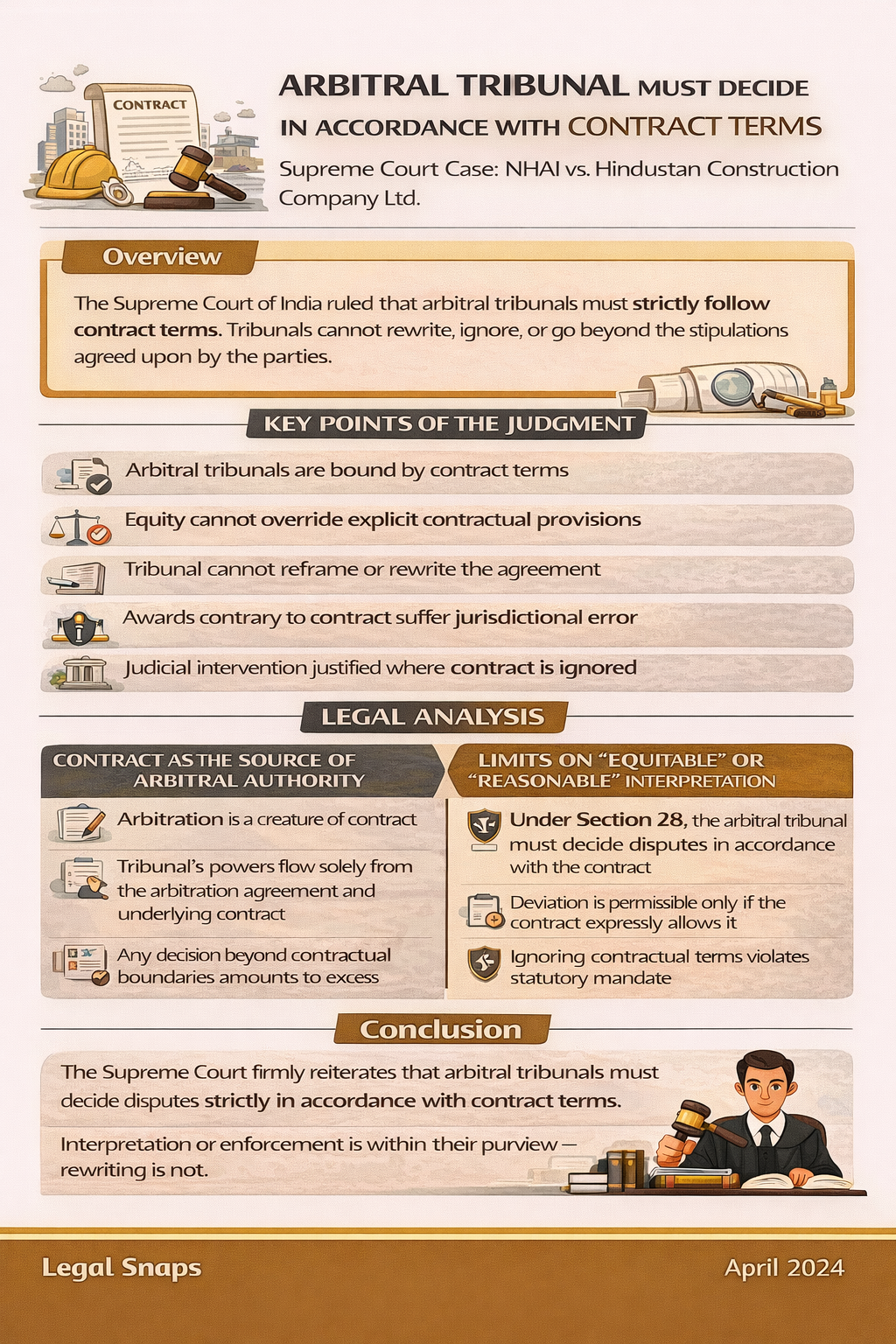
Arbitral tribunals must decide strictly as per contract terms.Equity cannot override express contractual provisions.Awards contrary to contract amount to jurisdictional error.Tribunals interpret agreements they cannot rewrite them.

Overview
In NHAI v. Hindustan Construction Company Ltd., the Supreme Court reaffirmed that an arbitral tribunal derives its authority from the contract and must decide disputes strictly in accordance with its terms. While tribunals enjoy procedural flexibility, they cannot rewrite or ignore contractual stipulations. Awards that disregard the contract travel beyond jurisdiction and are liable to be set aside.
Key Points
- Arbitral tribunals are bound by contract terms.
- Equity cannot override explicit contractual provisions.
- Tribunal cannot reframe or rewrite the agreement.
- Awards contrary to contract suffer jurisdictional error.
- Judicial intervention justified where contract is ignored.
Analysis
Arbitration is a creature of contract. The tribunal’s powers flow from the arbitration agreement and underlying contract. Decisions beyond those boundaries amount to excess of jurisdiction.
Tribunals cannot substitute contractual clauses with subjective notions of fairness. Equity operates within contractual limits, not outside them.
Section 28 of the Arbitration and Conciliation Act, 1996 mandates decision in accordance with contract terms. Ignoring express stipulations violates statutory requirements and invites interference under Section 34.
The ruling strengthens commercial certainty and party autonomy, ensuring tribunals remain adjudicators, not contract designers.
Conclusion
The Supreme Court has reaffirmed that arbitral tribunals must interpret and enforce contracts, not rewrite them. Awards contrary to contractual terms amount to jurisdictional error and are liable to be set aside. Contractual discipline remains the foundation of arbitration law.