Administrative
Land Acquisition Objections Are a Fundamental Right
The Supreme Court has reaffirmed that the right to object in land acquisition is a substantive safeguard.Authorities must meaningfully consider objections before final acquisition.Mechanical approval renders proceedings vulnerable to judicial review.State power to acquire land is sovereign but not absolute.

Overview
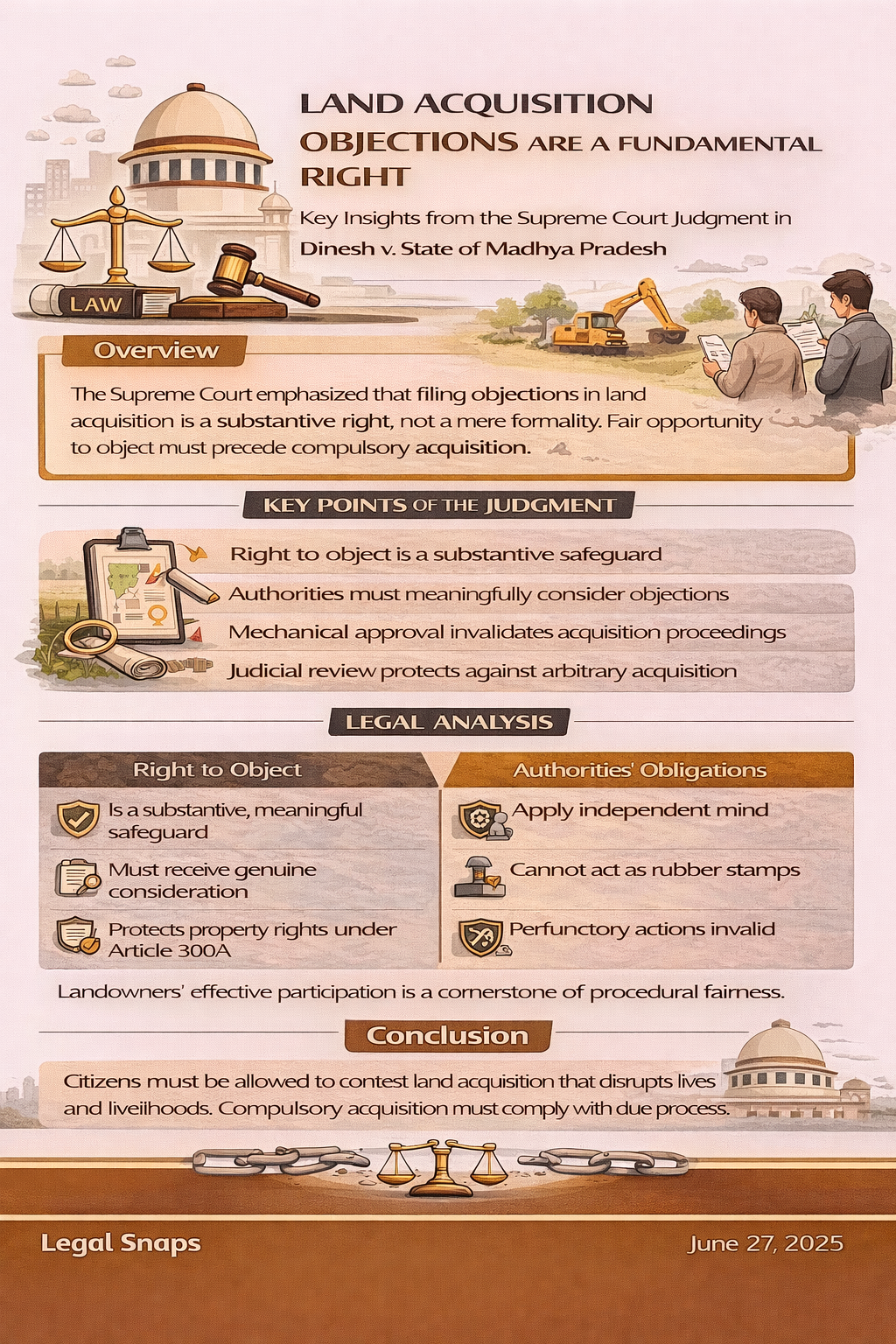
In Dinesh v. State of Madhya Pradesh, the Supreme Court of India reaffirmed that the right to file objections in land acquisition proceedings is not a mere procedural formality but a substantive and valuable statutory safeguard. The Court emphasized that affected landowners must be given a meaningful opportunity to object before their land is compulsorily acquired.The judgment strengthens procedural fairness in land acquisition and reinforces that state power must operate within the framework of due process. Compulsory acquisition, though sovereign in character, is conditioned by statutory and constitutional safeguards.
Key Points
- Right to object is a substantive safeguard.
- Authorities must meaningfully consider objections.
- Mechanical approval invalidates acquisition proceedings.
- Procedural fairness is integral to property rights.
- Judicial review protects against arbitrary acquisition.
Legal Analysis
The Supreme Court clarified that the statutory right to object under land acquisition laws is not symbolic. It is a substantive safeguard intended to ensure that affected landowners have a genuine voice before the State exercises its coercive power of compulsory acquisition. The opportunity must precede final decision-making and must involve active consideration of the objections raised.
The Court strongly disapproved of mechanical or perfunctory treatment of objections. Authorities are under a duty to apply an independent and reasoned mind to the material placed before them. Acting as a mere rubber stamp or issuing formulaic reports defeats the purpose of statutory protection and renders the acquisition process legally vulnerable.
Although the right to property is no longer a fundamental right under Article 19, it continues to receive constitutional protection under Article 300A. Any deprivation must be backed by lawful authority and must satisfy standards of non-arbitrariness. Failure to follow mandatory procedural safeguards amounts to violation of constitutional discipline and invites judicial correction.
The judgment reinforces that judicial review remains an essential check against arbitrary state action. Courts will intervene where objections are ignored, procedures are bypassed, or acquisition is tainted by mala fides. Sovereign power does not override due process; rather, it operates within its boundaries.
Conclusion
The Supreme Court’s ruling in Dinesh v. State of Madhya Pradesh firmly establishes that compulsory acquisition must be preceded by meaningful procedural safeguards. The right to object is a substantive legal protection that ensures fairness, transparency, and accountability in the exercise of state power.By insisting on genuine consideration of objections, the Court has strengthened due process and reaffirmed that property cannot be taken through mechanical administrative action. Land acquisition remains a sovereign power but it is not absolute, and it must always operate within the rule of law.